DibujoAhora! DrawNow! on Voice of Space
January 31, 2026
ViewOctober 17, 2025 – February 1, 2026
Voice of Space: UFOs and Paranormal Phenomena explores profound mysteries at the intersections of human experience, belief, and the unknown. As declassified government reports and an increasing media presence bring the potential for extraterrestrial activity into the spotlight, this exhibition examines the cultural, psychological, and metaphysical dimensions of this topic. What role do UFOs and paranormal phenomena play in shaping our understanding of the universe, and how do they challenge or expand our beliefs about humanity’s place within it?
Through contemporary art, historical works, and the lens of drawing, this exhibition traces diverse artistic responses involving religious iconography, psychological interpretations, technological advancements, and theories of interdimensional space-time. From ritual documents to speculative visions of the future, the show offers a broad perspective on how humanity has sought to depict, interpret, and question the unexplainable and how these ideas have influenced art and culture over time. Titled after René Magritte's 1931 painting on view in the exhibition, Voice of Space invites viewers to consider the ways in which these themes both live in our collective memory and influence our individual imaginations.
Featured Artists: Shusaku Arakawa, Roy Ascott, Stanley Brouwn, Alexandru Chira, Noland Oswald Dennis, Trisha Donnelly, Isa Genzken, Attributed to B Henderson (Arapaho Central Plains), Char Jeré, Jutta Koether, Pope.L, René Magritte, Paulina Peavy, Walter Pichler, Howardena Pindell, Sigmar Polke, Adam Putnam, Attributed to He Nupa Wanica (Joseph No Two Horns), José Trejo-Maya, Melvin Way, David Weiss, Stephen Willats, John Zorn
Organized by Olivia Shao, Burger Collection and TOY Meets Art Curator.
b. 1936 Nagoya, Japan. d. 2010 New York, NY
In Shusaku Arakawa’s Study for Moral/Volumes/Verbing/The/Unmind (1977), the artist explores the depths of the psyche and the potential expansion of perception through visual puzzles composed of radiating forms, grids, and intersecting geometries. In his paintings, Conceptual art, and his later architectural work done with his partner Madeline Gins, Arakawa defied everyday notions of spatial relationships, seeking new ways to contemplate reality, embodiment, and spatial reasoning.
Attributed to Arapaho Artist B, Henderson, Arapaho Central Plains
Native American visionary drawings, an understudied form of illustration, often depict traversals into alternate realms accessed through trance, dreams, or meditative states.
The hand, a universal symbol, often refers to spiritual healing and protection.
Attributed to He Nupa Wanica (Joseph No Two Horns), Hunkpapa Lakota, Northern Plains
Native American visionary drawings, an understudied form of illustration, often depict traversals into alternate realms accessed through trance, dreams, or meditative states.
The hand, a universal symbol, often refers to spiritual healing and protection.
b. 1934 Bath, England
Futurologist artist Roy Ascott has influenced art, theory, and education since the 1960s. Ascott blends Eastern metaphysics with cybernetics in a theory he calls “The Psibernetic Arch,” linking extrasensory perception (ESP) and information systems. “ESP is instant but sporadic. Cybernetics is universal but entropic,” he once wrote, and by connecting these forms of communication, Ascott opens the space for a new form of exchange. His “Change Paintings” (1959–60) and an untitled work from 1962 connect hexagrams from the I Ching with binary code, waveforms, and parapsychology, prefiguring ideas central to internet connectivity and network theory.
b. 1935 Paramaribo, Suriname. d. 2017 Amsterdam, the Netherlands
During his lifetime, stanley brouwn requested that his work not be reproduced, and he provided very little if any didactics to accompany his art.
b. 1988 Lusaka, Zambia
Based in Johannesburg, Nolan Oswald Dennis pursues a “para-disciplinary” practice spanning pictorial, sculptural, and spatial modes. Their work often references science and speculative fiction including the writings of Ursula K. Le Guin, Samuel R. Delany, and Octavia Butler, alongside historical struggles and anti-imperialism. With diagrammatic drawings such as studio notes II, Dennis explores new models for Black consciousness and planetary connectedness through the intersections of cosmology, geology, decolonial theory, and forms of resistance to
racial capitalism.
b. 1974 San Francisco, CA
Trisha Donnelly has been making drawings for the past twenty-five years. She was born in San Francisco and lives and works in New York, San Francisco, and Düsseldorf.
b. 1948 Bad Oldesloe, Germany
Isa Genzken’s drawings and wooden sculptures titled “Ellipsoids” (1980) were designed using early computer modeling yet challenge industrial Minimalism with their handcrafted intricacy. Working against the grid structures found in much Conceptual and Minimal art, Genzken’s sculptures pose complex forms of spatial understanding and reach toward infinite distance. The hovering forms, touching the ground at only one center point, suggest both the technological and the metaphysical, like shapes from beyond. In her “Weltempfänger” (“World Receivers;” 1987–2018), concrete blocks with antennae operate as psychic conduits, capturing signals and energies and opening channels to connect all existence across the cosmos. Her works function as UFOs themselves—technical, sculptural, spiritual transmitters linking to alternate realms of perception and being.
b. 1984 Rochester, NY
Working in a range of disciplines, spanning sound, installation, sculpture, painting, video, and film, Char Jeré has an artistic vision rooted in a philosophy they have coined Afro-fractalism, a term that builds on the foundations of Afrofuturism. Within this framework, time is conceived as nonlinear and multidimensional, a conduit that connects the past, present, and future through intergenerational communication with ancestors. Jeré’s work investigates fractures and connections within a Black diasporic history along with the possibilities for reclaiming and reshaping narratives around race and technology. Their collages, which synthesize a range of materials, incorporate incantations for time collapse and the summoning of spaceships as well as references to ancient cultural histories.
b.1958, Cologne, Germany
Jutta Koether has critically engaged with histories of painting, performance, and music for more than four decades. Several of her works capture the energy fields of the subjects being depicted. Untitled (1984), an early painting by Koether, suggests the beginning of the universe and of consciousness, whereas Koether’s artist book and drawings in the exhibition evoke celestial and vibrational forces.
b. 1898 Lessines, Belgium. d. 1967 Schaerbeek, Belgium
The Surrealist artist René Magritte’s Voice of Space (1931) depicts enigmatic orbs—an otherworldly presence looming over a pastoral scene. As Magritte described it: “I caused the iron bells hanging from the necks of our admirable horses to sprout like dangerous plants at the edge of an abyss.” As with many of Magritte’s paintings, the work disrupts typical planes of perception, acting as a signal from beyond—perhaps subconscious, perhaps technological, perhaps a transmitter or a gateway to other dimensions. Considering the interwar context in which the painting was made, these bells ringing “at the edge of an abyss” could be a warning about the specter of war haunting Europe; or, they may play the music of the spheres.
b. 1901 Old Colorado City, CO. d. 1999 Bethesda, MD
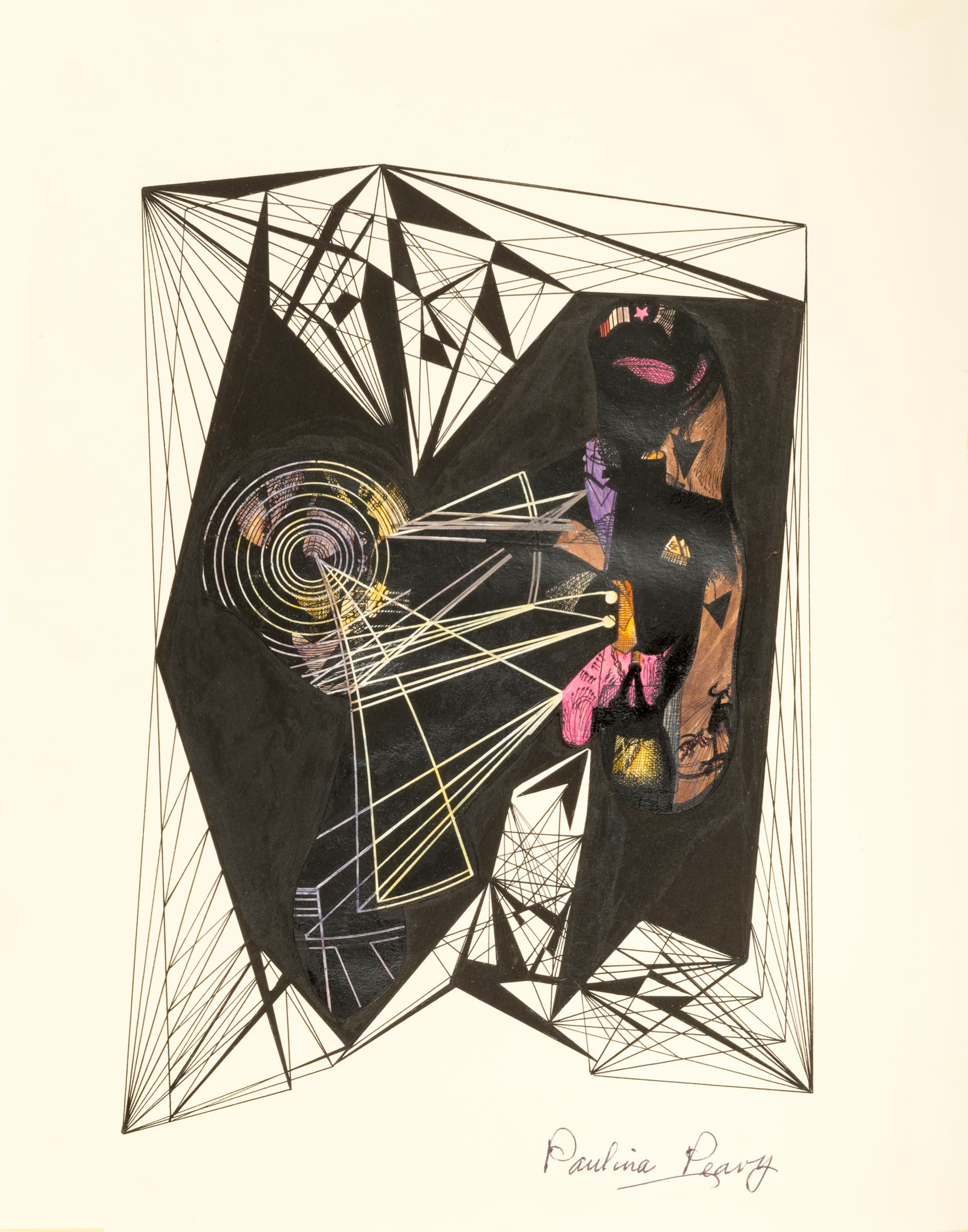
Beginning in the 1930s, visionary artist Paulina Peavy claimed to communicate with her personal UFO named Lacamo. Her multimedia works—paintings, drawings, performances, and writings—depict a cosmology in which humans evolve into spirits or UFOs over a twelve- thousand-year cycle divided into four three-thousand-year periods corresponding to the four seasons. These abstract, spiraling compositions map multidimensional space and portray divine or extraterrestrial consciousness.
b. 1936 Deutschnofen, Austria. d. 2012 Burgenland, Austria
Working across a range of mediums from drawing to sculpture and architecture, Walter Pichler explored themes central to his practice: the relationship between the body, perception, and time; reflections on machines and technology; and traces of personal and cultural histories. The drawing Loch im Kopf (1985) suggests a person being plugged into a network or having an abstract “hole in the head,” raising intersections between the brain, cybernetics, and society’s technological advances.
b. 1943 Philadelphia, PA
Howardena Pindell’s work has long imagined astrological movements. In 1982, her paintings were included in the Queens Museum’s “The UFO show,” an exhibition of sky-bound mysteries curated by Budd Hopkins. Pindell’s “Astronomy” drawings (2000–08) such as Astronomy: Northern Hemisphere (August-September 1997) (2000–01) continue the artist’s exploration of the physical and metaphorical significance of space, picturing small orbs that float mysteriously alongside interlocking ellipses, mathematical equations, and sun crosses.
b. 1941 Oleśnica, GDR. d. 2010 Cologne, Germany
Artist, alchemist, and polymath Sigmar Polke was one of the most significant artists among his postwar German generation. Several of Polke’s works reference receiving the “command of higher beings.” Beckoned in a manner both serious and with a sense of humor, these higher beings may be any form of authority or inspiration—from psychedelic mushrooms or the extraterrestrial to the divine, parapsychological, and other various forces and states of consciousness referenced in Polke’s vast, eclectic cosmology. In Command of 28.8.68 (1968), which depicts a possible communication or representation of a waveform signal, we witness energy forms capturing a life force.
b. 1973 New York, NY
Adam Putnam is a multidisciplinary artist whose elusive, shape-shifting practice employs performance, photography, and the creation of images on paper. These small, intricate drawings are part of his ongoing series titled “Visualizations,” which seem to capture dream fragments or psychic portals, revealing unseen forces and evoking both the universal mind theory and the Theosophical concept of the Akashic Records, a 19 th-century idea proposed by Helena Blavatsky comprising the cosmic memory or non-physical compilation of every thought and event.
b. 1980 Celaya, Mexico
José Trejo-Maya produces poetry, often printed on transparent film that he then assembles into sculpture. Trejo-Maya explains that the poems are not his making, but rather contain words delivered by ancestral and other spirits. He therefore defines himself firstly not as an artist or poet, but as a “remnant of the Nahuatlacah oral tradition, a tonalpouhque mexica, and a commoner from the lowlands from a time and place that no longer exists.” In Transparent Thoughts (2020), a poem visits a blank page. As the lines of text trickle down into nothingness, their diagonal trajectory suggests the poem’s unfolding beyond the plane of the paper.
In Islamic mystical traditions, the concept of Tay al-Arz translates as “folding of the earth,” traveling vast distances in the blink of an eye. “Voice of Space” includes a 19th-century diagrammatic map with inscriptions written in Farsi. The document would have been used in ritual practice, in which a person sat in the center of a candle-lit circle with twelve candles representing the months of the year.
b. 1954 Ruffin, SC. d. 2024 Smoaks, SC
Melvin Way was born in segregated South Carolina and moved to New York City in the 1970s. In 1989, his drawings were discovered at a homeless shelter, and he became a celebrated artist in the American outsider art community. Way’s dense, formula-filled drawings transmit messages of esoteric knowledge through symbolic languages that combine math, chemistry, and physics. He kept these intricate drawings, made on scraps of paper covered in Scotch tape, in his pocket like talismans until they were ready to be shown. In these equations, Way explored his own written form of infinity, which comprised chemical compounds that represent life forces, the secret of youth and immortality, sound and musical notations, travel in the space-time continuum, and the inner mechanics and mysteries of the cosmos.
b. 1943 London, UK
In 1962 at the Ealing School of Art, Stephen Willats participated in artist Roy Ascott’s Ground Course which inventively taught the principles of so-called “organic abstraction.” In Ascott’s class, Willats was introduced to the ways in which cybernetics and systems thinking can be used to analyze social behavior and how this might inform art. These concerns would guide Willats’s practice over the following decades. About his diagrammatic drawings, Willats explained, “The circle is like a ball of thought. Everything goes into it, and everything comes out—only differently.” Works like Travelling with the Good Connector (2019) propose speculative networks for transcending human constructs of time and dimensionality.
b.1953 New York
John Zorn is a composer, performer, artist, universalist, and aesthetic philosopher who has forged an independent path through stylistic domains that range from the classical avant-garde to many popular idioms. His work is remarkably diverse and draws inspiration from Art, Literature, Film, Theatre, Philosophy, Alchemy, Mysticism, as well as Music. He learned alchemical synthesis from Harry Smith, structural ontology with Richard Foreman, how to make art out of garbage with Jack Smith, and hermetic intuition from Joseph Cornell.
In addition to his composing, recording and performing, Zorn is a firm believer in community and a tireless champion of experimental music, film, art, poetry, and theatre—organizing festivals, recordings, concerts, and helping to establish venues and opportunities for performance. He founded the Tzadik label in 1995, runs the performance space The Stone at the New School, and has edited and published ten volumes of Arcana: Musicians on Music.
Earlier this year, The Drawing Center presented Zorn’s first ever exhibition Hermetic Cartography, which featured his never-before-seen visual artwork, graphic scores, dense philosophical notations, abstract poetry and artist books, along with his Theater of Musical Optics. Zorn's abstract drawings reveal a private language of symbols and notations, and are a visionary approach to mark-making, improvisation and the esoteric.
b.1946 Zurich, d.2012 Zurich, Switzerland.
David Weiss grew up in the suburbs of Zurich. Throughout the 1970s he spent a lot of time commuting from Zurich, with longer periods in Los Angeles and Carona. In this decade he created a large part of his multifaceted and rarely seen early work comprising some 3000 works – mainly drawings and watercolors on paper, texts and artist books. The Metamorphoses works are drawn in black or blue ink on multiple sheets of standard letter-size paper. Each image organically generates another, resulting in a series of complex visual associations that anticipate Fischli Weiss’ celebrated film The Way Things Go, 1987.
From 1979 on he worked together with Peter Fischli as Fischli/Weiss, becoming one of the world most renown contemporary artist-duos, with major museum retrospectives at TATE Modern, London and the Guggenheim Museum in New York among many others.
Generous support for Voice of Space: UFOs and Paranormal Phenomena is provided by Stephen Cheng, Kent Shao, the I.A. O’Shaughnessy Foundation, the Teiger Foundation, Sarah Arison, Martin and Rebecca Eisenberg, and Laurie and David Wolfert.
January 31, 2026
View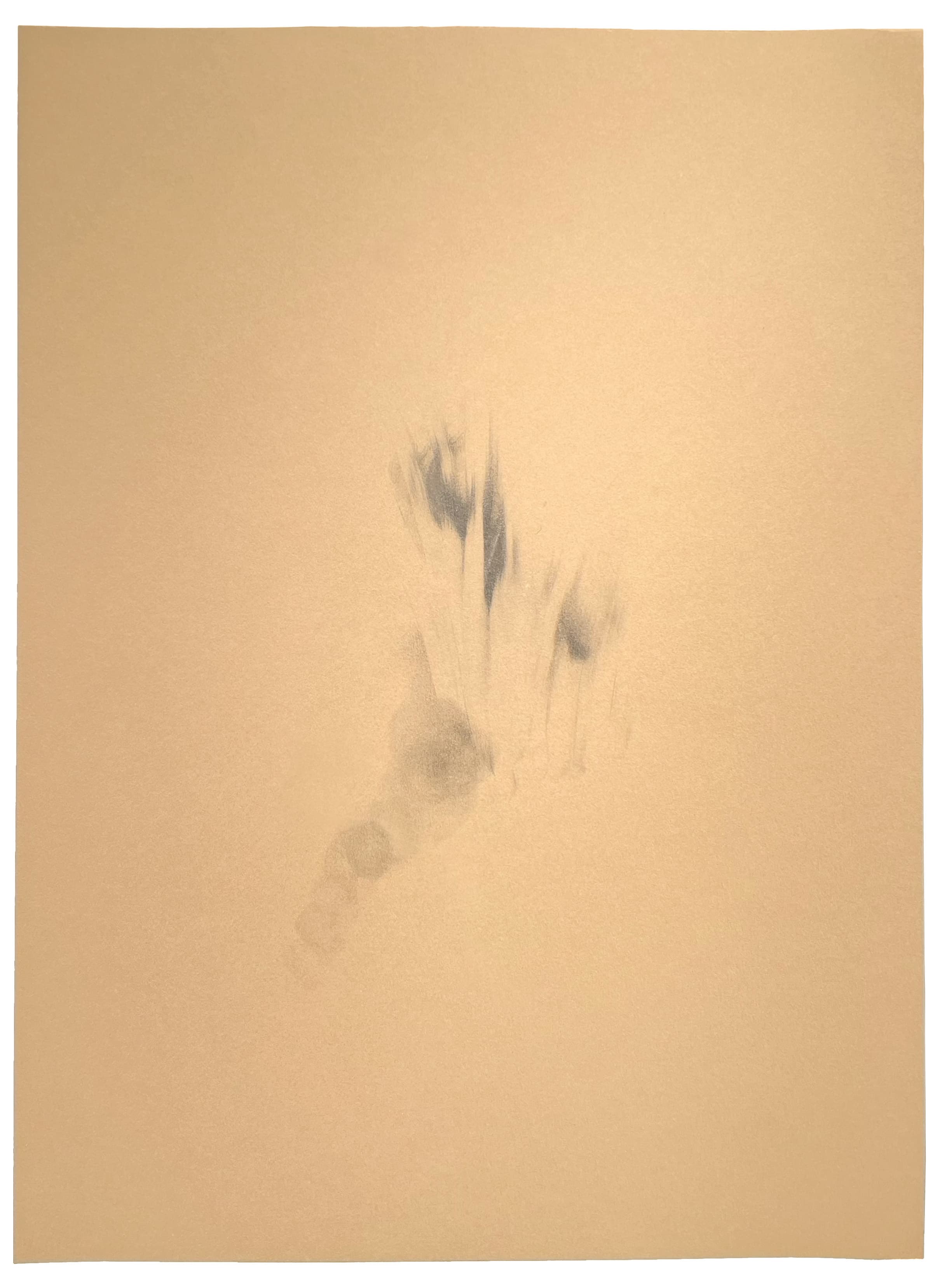
January 31, 2026
View
January 15, 2026
View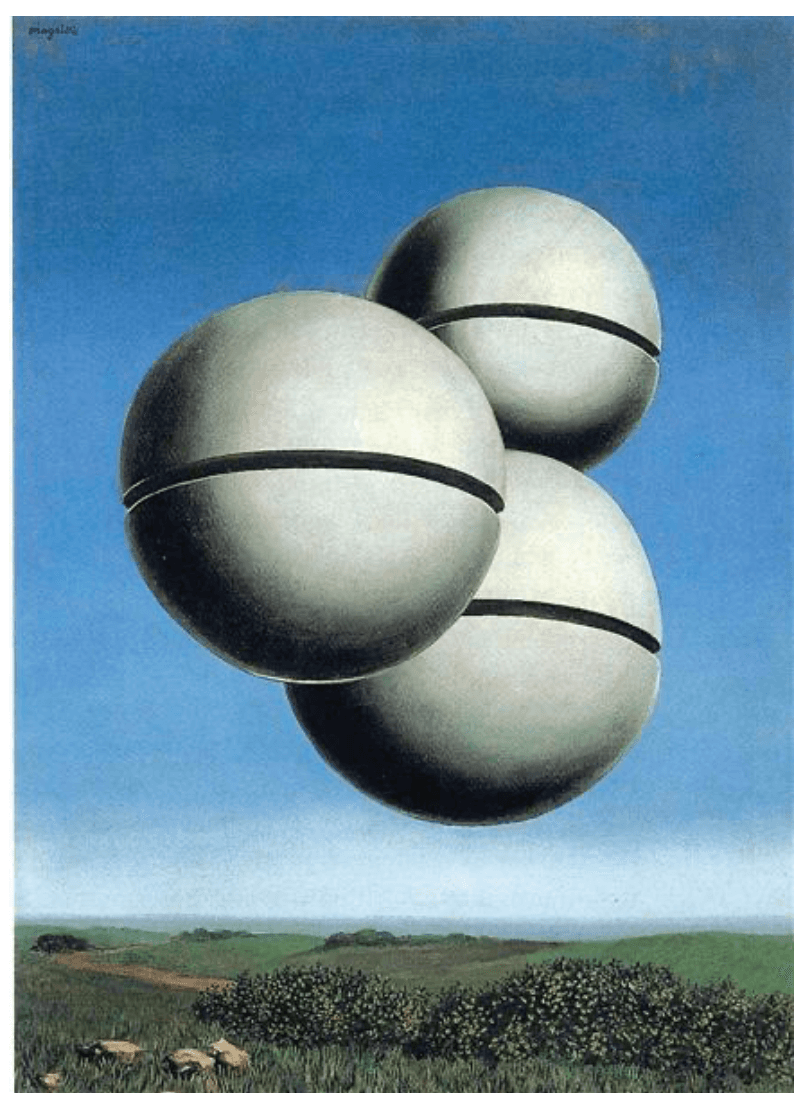
January 9, 2026
View
January 8, 2026
View
December 20, 2025
View
December 11, 2025
View
November 13, 2025
ViewNovember 9, 2025
ViewOctober 23, 2025
ViewOctober 18, 2025
View
October 16, 2025
View