Frank Walter: To Capture a Soul
June 21 – September 15, 2024
Learn MoreA Beautiful Mind: Frank Walter and Creative Expression
August 7, 2020
Aimee Good:
Welcome everyone. My name is Aimee Good. Welcome. I direct our education, community and public programs here at the Drawing Center. We're so glad that you're joining us this evening for this beautiful conversation on Frank Walter. A few things before we get started. Grateful for the support of the generous funding made possible by the Andy Warhol Foundation for the Visual Arts. Sandra Weinberg and Hugh Freund, Alaina Bows, Noel ED Kernan, Frank Williams, and an anonymous donor. Our exhibition catalog is made possible by David Zwirner. Thank you. I'd like to turn it over to my colleague, Isabella Kapur, who's our assistant curator here at the Drawing Center.
Isabella Kapur:
I will just briefly do some introductions on our panelists tonight. Billy Gérard Frank is a multimedia artist and filmmaker who lives and works between New York, Grenada and Paris. His research-based practices interrogate personal issues dealing with race, exile, memory, global politics, and post-colonial and queer decoloniality, challenging normative discourses around them while imagining and creating counter histories. Frank is also one of the founders of the Nova Frontier Film Festival and Lab, which showcases and incubates the works of filmmakers and artists from and about the global African diaspora, the Middle East and Latin America, and is also a lecturer in directing and design in the David Geffen School of Drama at Yale.
Vladimir Lucien is a writer, actor, and critic from St. Lucia. His debut collection of Poetry, Sounding Ground won the 2015 Bocas Prize for Caribbean Literature. Lucien is also a co-editor of Sent Lisi: Poems and Art of Saint Lucia and the screenwriter of the 2012 documentary, The Merikins. His criticism and essays have also been published widely in journals such as PN Review, Asymptote and Poetry International. He contributed a collection of poems entitled Luminous on the Light and Its Birds in Frank Walter's paintings to the publication for Frank Walter: To Capture a Soul.
Barbara Paca was a close friend of Frank Walter and now represents the Walter Family Trust with the artist's family members. Paca is a full research professor in the Department of Anthropology at the University of Maryland, College Park, and also teaches in the School of Architecture and Planning at Morgan State University in Baltimore. In 2018, she was recognized by Queen Elizabeth II with an order of the British Empire and currently serves as cultural envoy to Antigua and Barbuda.
Claire Gilman is currently Acquavella curator and department head, modern and contemporary drawings at the Morgan Library and Museum. She worked here at the Drawing Center as curator for 14 years serving as chief curator since 2018, and she's of course also the curator of Frank Walter To Capture a Soul.
Claire Gilman:
Thank you Izzy. Thank you so much for coming this evening and it's a real pleasure to be back here. As Izzy said, I was here for 14 years and have just started my new position just for... This is my third day, so it's a real pleasure to be back at the Drawing Center.
I thought it would be helpful to have a brief overview of Frank's key points in Frank's life, and then I'm going to turn things over to Barbara who can give more information about Frank and then each of these wonderful individuals here with us tonight who comes to Frank from a different place. So very quickly, Frank Walter was born in 1926 on Horsford Hill, Antigua as Francis Archibald Wentworth Walter, and he died on Bailey's Hill, Antigua in 2009. He was the ancestor of both white plantation owners and enslaved Antiguan's and spent much of his life kind of wrestling with his origins and sort of searching for his, trying to sort through his ancestry.
In 1948, he was the first person to break through the color barrier on the island of Antigua. And at the age of 22, he was promoted to the manager of the elite Antiguan Sugar Syndicate. He took a trip to Europe in the early fifties partially in quest of his roots, and here he encountered a kind of intense racism that he hadn't experienced before, and it was a very difficult period for him. Barbara may speak about this a little bit, but he spent the next years essentially in poverty, in and out of institutions, finding solace in libraries. He was a great researcher and a great scholar of languages.
He returned to Dominica in 1963 and then eventually made his way back, sorry. He went to Dominica and then eventually made his way back to Antigua where he set up for a number of years, a photo studio, and he made sign paintings for tourists. And he did that for 10 or so years, something like that, or more than that. And then in 1993, he designed and built a home and art studio and gardens in a remote location on Bailey's Hill. And essentially there for the remainder of his life, he took refuge in his surroundings, drawing and painting. He had been drawing and painting throughout his career, but during this time, that was really his primary focus.
And all in all, by the time of his death, he had left behind over 5,000 paintings, 1000 drawings, 600 sculptures, 2000 photographs, 468 hours of recordings, and a 50,000-page archive. So we're going to speak a little bit about that. So I came to Frank's work through the remarkable efforts of Barbara, over here to my right. Specifically, I saw the exhibition that Barbara put together at the 2017 Venice Biennale where Frank represented Antigua and Barbuda. And since then I haven't been able to get him out of my mind as happens with many people who fall in love with Frank.
And so I was really happy to be able to finally put together an exhibition of his work. And with me tonight, in addition to Barbara are Vladimir and Billy, and I think each of them brings a unique perspective. And really the purpose of tonight is to allow three people with different vantage points to kind of give their impression of Frank and what Frank has meant to them and bring their perspective to Frank. So Barbara is someone who knew Frank very well, can actually tell us about his life and who he was as a person and how that impacts his art.
Vladimir did not know Frank's work, I think at all, until I invited him to write a series of poems based on Frank's work for the catalog. So he's coming at him from a literary perspective and someone who did not know Frank's work prior to having this opportunity to engage deeply with him. And Billy is an artist who is originally from Grenada, who has known Frank's work for some time, and I think can speak to his importance for artists both from the Caribbean and Caribbean diaspora as well as more generally. So I want to start with Barbara over there, I would just love it if you could sort of talk a little bit about Frank. And if you could tell us a little bit more about his extraordinary story and also sort of what you would want our audience to know about Frank.
Barbara Paca:
Thank you. Well, thank you all for gathering tonight, and I just want to say it's really been an honor to work with everybody at the Drawing Center. You guys are incredible. This is definitely the coolest museum in New York, so it's been wonderful and it's been also really important to me to engage with Lucien and Billy about their work as Caribbean artists because it's helped me to answer a lot of questions I have about Frank Walter. So can you kind of raise your hand if you just don't know anything about Frank Walter. Good. That's good. Wow. Have you had the chance to see the exhibition upstairs? A little bit. All right. Well, I mean, you're in for a treat.
Frank Walter is a person I met by accident 20 years ago, and I was kind of at one party and I was invited to another party and I had sort of seen his work by accident in a house where it seemed very out of place. And I met a family member and asked about Frank Walter because I was told that he was no longer living. And the person said, "Well, he's very much alive. May I take you to him?" And I wasn't expecting that at all, particularly the journey which was up a very steep hill, which was partly on a road. We were in a truck. So part of the journey took place on a road, and then it was definitely not a road. And then we had to walk and it was incredible. I knew Antigua quite well and I was in a part of Antigua that was completely wild and the most beautiful beach I've ever seen in my entire life, which still belongs to the Walter family. It's called Rendezvous Bay. It's incredible. And I politely waited outside while his relation, who speaks with the same kind of Winston Churchillian accent as Frank, spoke to him in Latin through the walls of this house.
And when the door opened, there was this man so elegant that my heart stopped beating and he was clad in a curtain and his walking stick was a shovel. And one of my friends who's here tonight, is Professor Nina Khrushcheva from the New School. And we met because we were both members of the Institute for Advanced Study in Princeton, having done our doctoral work there. And we were there during the days of John Nash and other very eccentric, brilliant people. My professors always said, "You're always in trouble. Knowing you, you're going to meet a genius and it's going to be different." So that was what everything hit me at that moment.
And it was like experiencing John Nash, but in a much more interesting and enriching environment. So there isn't a day that goes by when I don't think about Frank or talk to Nina about Frank or other people. So he was a remarkable, remarkable man and absolutely gifted and just operated at a completely different level. One of the things that was great about working with a lot of people to create a national pavilion for Antigua and Barbuda at the Venice Biennale was seeing the work of other people. I was in Venice, I was able to see Billy's work for the National Pavilion of Grenada. I learned about Vladimir's work on the island of St. Lucia, and it just helped me understand this constellation, this world of Caribbean art, about which I knew very, very little. And so it's been an incredibly enriching experience for me. So I would really be happy if Vladimir might read one of his poems.
Claire Gilman:
Yes, certainly. Yes, we will. And I thought we can go to Vladimir immediately or maybe one more question I had to you, Barbara. Well, just building off of, you mentioned John Nash and I know that you have overseen many exhibitions of Frank's work and I very much appreciate you letting me have my vision for this show. But I also know that there were certain curatorial decisions that were important to you in this show.
One of them being that central wall, which I know you did think about in relationship, and called sort of the Beautiful Mind wall. And we're thinking about in relationship to John Nash. So I don't know if you want to talk just a little bit about that, what that meant to you to have that in the show.
Barbara Paca:
Would you raise your hand if you saw the movie with Russell Crowe called Beautiful Mind? Well that movie, sorry? Thank you. Thank you very much. Most people know it's America, right, Nina? So Nina teaches propaganda. So we know the movies in America. How do you say... Actually, professor Khrushcheva very kindly loaned four works of art that she had from her collection of Frank Walter to help explain the complicated story of how this man's mind worked. But I think when we worked on the catalog for the Venice Biennale, actually a team of neurosurgeons came to Antigua and they treated people who had epilepsy. It was amazing.
They treated 250 people and it was neurosurgeons, neurologists, neuro nutritionists. I mean, it was a huge group of people that came down. And again, I learned so much about how differently people can think, especially when they're operating a very high level. And so one of the neurosurgeons wrote a very beautiful essay in the Biennale catalog. It's only three pages long, but she went through the 50,000-page archive, which has been digitized and cataloged and conserved by the family. And she said basically, "This man did not suffer from madness. He suffered from genius. And had he been in the United States of America, he would've been drugged and institutionalized and unable to pursue his art."
Again, his family was incredible. And they realized that they respected his wish to live in solitude. And so he was able to engage in the natural world and create beautiful works of art.
Claire Gilman:
And I think that that center wall is in a way, a place where we see all the different aspects of Frank's work coming together. So as Barbara said, we have some of his actual what we would consider his artwork, and we also have some of his poems and we have some of his photographs and we have some of the kind of ephemera that was found in his studio. And so it's sort of this place where you see just the vast expanse of his intellect and of his interests and the way he reached out into so many different areas and disciplines.
Barbara Paca:
Yes. Nina wrote in the Venice Biennale catalog as well and came up with the term that he was the last universal man, which is true. And I think one of the things you see on the beautiful mind wall is just a little bit of his genealogy. He was really obsessed with family history and it was because he actually knew the truth about his family when he was made manager, the first person of color to have that honor on the island of Antigua. He managed, ironically, a sugar plantation. And his grandmother said, "That's wonderful, but your ancestors actually owned those plantations."
So he was faced with this kind of shock and guilt of learning that he descended from German plantation owners. And so it was something his cousins didn't know, members of the family didn't know until we started this journey 20 years ago. And in doing the family history for my godson, who is his great nephew who just turned, I think five. I traced the family back to Germany to 1550 and actually went to the village where the Walter family's from and there's a Walterstrasse, and they were delighted to know that they had Antiguan relations. And so it's a very complicated story and to try and explain all of that on the beautiful mind wall was more like an emblem.
Claire Gilman:
Like a snapshot. Just a gesture to that rather than a real explanation.
Barbara Paca:
It is a 50,000-page archive. So it was tricky.
Claire Gilman:
So Vladimir, you, as I mentioned before, we're not familiar with Frank's work before I approach you for the catalog. And so I'm curious what that process was like for you before you read some of your work. He created an app. You ask poets sometimes to write for catalogs, you don't know what they're going to do, but oh my goodness, you rose to the occasion I think beyond anything I've seen.
I mean you wrote the most extraordinary suite of poems that were so responsive to the work. And I'm actually curious, I don't even think I even know, had you ever written about an artist's work before in this way? So what was that process like for you? Tell us a little bit about that before you read.
Vladimir Lucien:
First, let me say thank you as well for commissioning me to do this. And it was quite an experience for me because I'd never come across his work and I considered myself someone who knew at least a little bit about the painting and art world of the Caribbean. But with the Caribbean, things are always very spread out and it's easy to miss something. But in some ways I found that the person I was discovering had some of the features of the Caribbean artist in certain ways. That sense of working within multiple mediums is something you find that's very, very common in the Caribbean because usually you have to be chief cook and bottle washer on the island when you're there.
So you have to write the play and produce the play as well and so on. So you generally find that that's both a strength and a weakness. A weakness perhaps of the society, but a strength in the artists because they eventually end up not being jack of all trades, masters of none but masters of many trades. And you could see that in a lot of the artists that I didn't know, for example, like Aubrey Williams. All of these guys, they wrote on art, they wrote, they wrote poems, they did that, but he seemed to do it in a more frenetic and prolific way. I don't know, his work ethic seemed to me... I couldn't imagine what it was like because of the amount of work that he produced and all what he was trying to do.
I remember when I just came across and I was going through some of the, I saw the paintings, but I also saw the little writings and jottings here and there. In some ways at the time I was actually learning languages and I was like, "What is it with us?" There's something in the Caribbean where people generally very hungry for all kinds of knowledge, I think. I've found that amongst Caribbean artists all the time that there's just that, because part of it has to do, I think, to some degree with living in a society where certain opportunities for you as an artist may not be available in a very, how to put it?
There are opportunities, but not in the traditional sense, not institutional support. And I think when you do get institutional support, you tend to make the most of it and more. Well, it's interesting with him because he was doing a lot of this on his own and at that level and that amount, that volume I found just spectacular. So for me, I recognized him based on writers, painters. I knew about whether through reading about them or that I knew directly, but also it was just at another level, on another scale. And in connecting with it, I mean, I just tried to...
As I do with a lot of these writers that preceded me or painters that preceded me, I try to imagine that they were like me, a little Caribbean boy growing up with similar circumstances. When you go to the different islands, you see the similarities of the realities there. And I just took it from there. I know that he produced what he did out of a certain experience, and I know that that experience is not quite... It's very different, but also not quite different because the Caribbean moves from one era to another, not that quickly. We tend to keep a lot and move to other things. It's like a melange of the present and the very distant past.
So that's the approach I took to it. And of course, taking in the paintings themselves. Very interesting paintings, very airy in some ways for me. I started to look at what was being repeated in the paintings because it was quite obvious and start to take him in through that in a way. And it was just really a fascinating experience for me. I mean, I had some months to take it in and I would go through it, go over read about him, read the stuff he was writing, and it was just startling and happy discovery for me.
Claire Gilman:
And you came to focus on the birds primarily, and was that something that sort of struck you from the beginning or was that sort of in this process of looking and looking again they kind of came into view?
Vladimir Lucien:
From the beginning, I mean from the time I was like, "What's with all these birds?" And always in a certain kind of light, the birds were not just birds in various different... Whether the setting changed or not, the light always seemed to be something that drew a certain kind of serious attention to the birds, even though the birds were plenty. And it made it even more startling for me when I came across that one painting where it's a singular bird, an egret, which you'd always see in the Caribbean, especially when you've just cut your grass or something, they land there and look for, I don't know, worms or insects, but it's a huge bird.
I don't know, if you see, it's out there, so you should look for that painting. It's a huge bird. It just seems out of scale with a lot of things there. But it's so much in tune with the rest of this stuff, with the kind of light that the bird is in. And I just found it very haunting in a very moving way. And I couldn't tell you what it did, but it did something. It was just like "urgh". Something like that. And that's kind of where the work took off from and imagining the person producing this work, especially with paintings that constantly repeat that quality of light. So that's kind of where it took off from.
Claire Gilman:
So would you like to read us something?
Vladimir Lucien:
How much do I read?
Claire Gilman:
Let's see. Why don't you read one part or one piece where you feel it comes to a stopping point for you? Or one poem, they're separate poems.
Vladimir Lucien:
They are.
Claire Gilman:
Even though there's sort of one also there are stopping places.
Vladimir Lucien:
Luminous. Stained curtain of twilight, shadow, excruciating sunset. The color of pain we have accepted. Pain we have resigned ourselves to, and yet none of this is real. Neither the evening nor anything I can say about it. All of it still just a suggestion of something other. A reference to a reference to an infinity of references. A metaphor for an infinity of metaphors. That's the cosmos. You know this Frank. Yet there in front of you, the mirage insisting upon itself, the stale light pressing itself, convincing orange against the curtain. Go outside, forget what you know about the cosmos, join the evening for the evening.
Claire Gilman:
You see what I mean? It's just extraordinary. I mean extraordinary words and so perfectly to me. And I think to Barbara, I sent it to Barbara right after you sent it to me. I said, "Can you believe this captures Frank?" And I think the thing about Frank's work is this melding of reality in the imagination, how he is looking very closely at the world around him, but he is bringing to that looking his own fantasies and his own sort of vision of things at the same time. And where you say in there, I can't remember the exact words, but that this is sort of exactly what you say, you are looking, but it is at the same time just a fiction or you say just a fantasy.
The way those things come together seamlessly in his work. And actually I think this is also a good moment to turn to you, Billy, because I know from the opening lines where you're talking about this pain and this sort of intensity and I think that that was something that you responded to in Frank's work. And earlier just tonight we were talking about that because many people go through it and they think, "Oh, these are so beautiful, calm." But if you actually look closely at Frank's work, there is a real intensity there as well, they're not just calm, idyllic scenes. So maybe you want to speak to that a bit.
Billy Gérard Frank:
Thank you so much for the opportunity to be here to speak about Frank's work. And I came to Frank's work in the early 2000 via another artist called Canute Caliste was actually from Carriacou. He was an entry in artists who sort of was in the same age group as Frank. And his work was very narrative driven, dreams as well as depictions of the Caribbean but his own experience of culture. He's never left the island. And I'm not sure at what level he left school, but was also a brilliant artist who just worked from his mind and produced hundreds of work as well.
I met him through someone similar to Barbara, was curating his work and help to get his works seen in an international stage. And Frank's work came up quite often, very different kind of work, very different kinds of expression. But my work is nothing like Frank's work, but Frank's work has always been a big inspiration for me in the sense that he was a polymath. And I myself work in multiple medium as a multidisciplinary artists who make films as well as production design and write as well as paint. I've always been inspired by the creative freedom that Frank has.
And as Vladimir was saying, Frank is definitely a product of the Caribbean. When I see Frank's work, I think of my own father as well. He was a boat builder, fisherman, he spoke languages. He also was an architect and this was all sort of untrained skills that he developed out of necessity and survival. But towards the end of his life he also built a house similar to Frank and left the family and went to live out in this hut that he built to be by himself. So this is very much, when I think of Frank and the legacy of my own connection to Caribbean artists and the multiple complex storylines, I think complexity might be the wrong adjective to use.
What I'm thinking of Frank, I think more of enigmatic. In terms of my own dad, I could never really get to know this person. He was an enigmatic character. In my 2019 Venice Biennale work, Second Eulogy: Mind the Gap. That work was inspired by my father and going back to the Caribbean to Grenada to take him into a nursing home and having to sort through some of his own archive. I found a suitcase with letters and mops and all kinds of strange things that he collected over the years. And that sort of became the impetus for this body of work.
I brought the suitcase back to New York and when I was invited to partake in the Venice Biennale, I knew immediately that was a space I had to go to in terms of the work. I'm also very interested in Frank's work in terms of, because my own work, my autobiographical memory auto fictional and cultural memory, political memory, social memory. I'm very interested in Frank's work in terms of this idea of invention out of fiction and the space in which Caribbean artists specifically has to go to in terms of inventing something new.
And also there's a kind of creative freedom that lies in that as well, because they're not mortgage by institution, most of them are self-taught artists. So the space in which they're operating from has total freedom. I myself has never had that type of... I left when I was 16, started in institutions in the United States as well as Europe. So in a way my own influence has been very much European and Europe was a place I looked to, not necessarily the Caribbean.
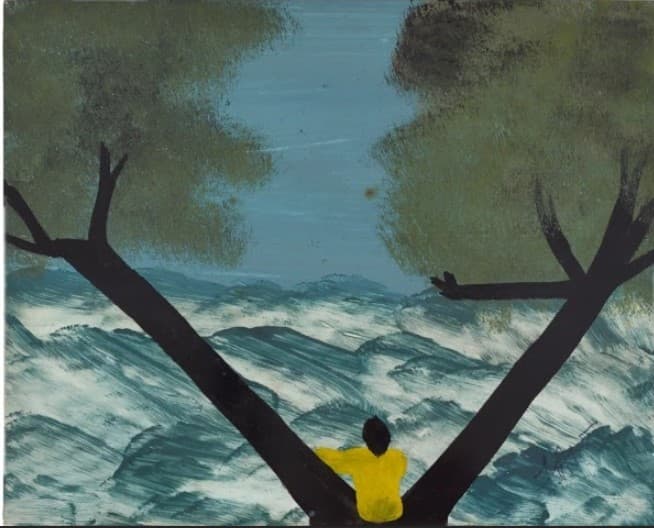
And it's only maybe in the last six or seven years the Caribbean has become the center of a place that I studied because there's sort of... I had an exile around my own family as well as the Caribbean. When I think of Frank's work and I look at the work, there is an exile, even though he lives in the Caribbean. For instance, I was talking earlier about his self-portraiture. They're very strange and one of them a figure is looking at a turbulent ocean.
Claire Gilman:
And this is in the show upstairs.
Billy Gérard Frank:
You never really see the figure's face and they're titled Self-portraiture. In another one, there's a figure who is looking at a white dog. I think the piece is also called White Dog, Black Dog. And the figure's looking at minions in white dog, but there's a black dog that's behind him that is sort of nonchalantly walking. What is he trying to confront? What is he dealing with? There is another figure standing in a forest that definitely is not the Caribbean.it is a forest that is somewhere in-
Claire Gilman:
It's probably Scotland.
Billy Gérard Frank:
Scotland, some place like that.
Claire Gilman:
Because a lot of his work, he spent a lot of time in Scotland.
Billy Gérard Frank:
That's right.
Claire Gilman:
And he did a whole body of work from memory. So his Scottish landscapes are memory landscapes. He made them at the same time as he was making his landscapes.
Billy Gérard Frank:
They're very interesting work in the sense too, because in Frank's work, there's a disavowal of some of the primary colors that we associate with the Caribbean and all the colors, the sort of muted tone, they're very gray. They looked like a landscape that one would see from a European painter. So even though he lived in the Caribbean, he was having a conversation with institutions in Europe and that kind of training that one would associate with painters that was trained in Europe, not necessarily from the Caribbean. And also I think of someone like even Derek Walcott who also painted and his poetry even complex people say V.S. Naipaul had a very complicated relationship with the Caribbean. Jamaica Kincaid.
So there's multiple people in spaces that Frank is sort of embodying here in this work when you look at the work and when you think of Frank's work as well as his writings that are very actually quite beautiful. And of course I see a lot of European influence in the writing and his thinking in terms of... I remember my dad was very drawn to prosecution and theosophy and that was something that caused a lot of his own exile from religion and ideas that he was exploring. And I see that in some of Frank's work as well. So it's kind of complex, enigmatic type of work.
Claire Gilman:
And I wonder a bit about, you talked about this and that was really useful to hear you saying Vladimir, that it's typical of artists from the Caribbean to work in multiple media because they sort of just need to use what's around or they need to invent, they need to take whatever opportunities come to them in a way. But I wonder if also, and I don't know if you can speak to this, if you know Barbara, a little bit more about this. Whether that need on the part of Frank to work in all these different media had to do with the fact that no one medium could provide the answer for him in a certain sense because he was in between so many spaces.
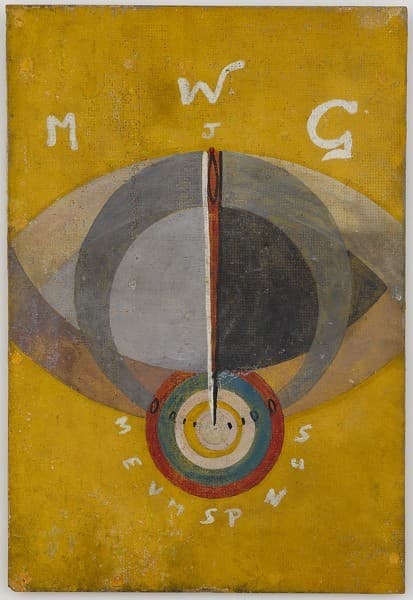
I think as you're saying, that's absolutely right. There's European influence, there's influence of all the places he's been and then there's very close looking at the world around him. There's utter fantasy. He did these series based on this galactic series, he became interested in other worlds and created these near-abstract compositions. So they're operating in an entirely different world. And so I wonder if that maybe it's like, he could do something in poetry that he couldn't do in the painting, and so he needed both of those things. Or there was something he could do in his carved sculpture, maybe his carved sculpture fulfilled something again that his paintings didn't.
And then his autobiography is another thing really entirely. And his genealogical charts searching for his ancestry, which was both quite accurate when he was tracing his German side like you were saying. And then absolutely probably fiction, maybe there was some hint of, he had this idea that he was descended from Charles II and he created an elaborate genealogy around that. So this mixing of facts and fiction and this occupying different media, did that have something to do with the sense that no one medium was going to satisfy him. He needed these different places in which to express himself. I don't know. If anyone has thoughts about that.
Barbara Paca:
I think Vladimir and Billy have kind of highlighted that. I wouldn't say that Frank... I think that Frank had certain levels of reality and they were very real to him and he could describe them as beautifully as Vladimir and Billy have. So they were very real places to him. One just accepted that. And there were certain family legends that I've heard for a long time, and we all know from Thomas Jefferson and Sally Hemings that people didn't always make things up. So one has to keep a very open mind and just try to be a good listener.
Billy Gérard Frank:
And I do think that Frank, he's a colonial prophet as well and also as a generation. As I was looking through some of his work in terms of the genealogy, and one question, is this invented? Is it real? I couldn't have to think about Equiano's work, Interesting Narrative. A lot of scholars had said the book is not based on facts, that he invented this whole world. And when you begin to think of Caribbean artists as specifically Black artists and the way in which, if that is true, then he was quite a genius to invent this narrative and to make this work.
So this also falls into this idea of art of fiction and the fact that black artists sometimes have to create alternate fiction or reality in order to survive the trauma of racism or the trauma of slavery. In Frank's instance, he experienced racism when he went to Scotland. So it was necessary for him to create certain kinds of stories or narrative in order to exist in his own head or in his own mind and to get a wider acceptance on the island. And one could elaborate more on this idea of invention, of this narrative and the way in which Black people have been able to reinvent certain aspects of their life in order to survive certain kinds of traumatic experiences.
And when I think of Frank, and then I think way back to 18th century when Equiano wrote that book and even the title of the book, Interesting Narrative. One automatically assumes already the person who's writing the work already knows this work is sort of fiction.
Barbara Paca:
Frank arrives in London and it's August, it's 1953, and he's just broken the production records for sugar production in Antigua for five years. I mean, he's incredible. And his cousin, who's the love of his life who lived into her late nineties and she didn't even know he was in love with her. So he escorted her to London and she was the first woman of color from Antigua to graduate as a barrister, and she went to Gray's Inn. So she had a very good education. Frank is taking Eileen Galloway his friend to meet their mutual uncle in Tottenham Court Road in central London. And Uncle Carl is this very tall, very handsome, famous kind of actor.
They called him the Black Prince from Antigua and he played in Victor Korda films. He was this very, very elegant man and he took her by the hand and said, "You'll pass for white, but he won't." And he left Frank Walter standing in the middle of Tottenham Court Road. I heard that story as many times as you've heard your grandmother say that story that you've heard 5,000 times. And he never said it with any bitterness or any anger or any sorrow, it was just a fact. But imagine, and she went on to study law. He goes to try to find a job and he's a reader on BBC. He's reading his poems on BBC, right?
So he goes to get a job and they said, "Tell us what do you do?" And he said, "Well, I was a manager." It was a big deal. And they said, "Well, what did you manage?" And he said, "Well, I managed a sugar plantation." They said, "Well, we don't have any sugar plantations here in London, so you can sweep the floor or you can clean the toilet." Seriously. I mean, this is his story. And I verified it. I've gone to every place Frank Walter lived in London, in Leeds and Stoke-on-Trent and all the way up to Scotland. He was only in Scotland for 36 hours, by the way. He's in London-
Claire Gilman:
And he wrote a text called 36 Hours in Scotland.
Barbara Paca:
He writes in his 6,832-page autobiography. And that's just one draft of it by the way. Probably 2000 pages of it are about Scotland. It's really quite amazing. It's beautiful.
Claire Gilman:
And so much of his work is about Scotland.
Barbara Paca:
But he's not bitter about anything and he's telling you this story. But I think the conservator whose work, the family's engaged a very good conservator who's now in his mid-eighties to save the papers, to save the artwork. And he said, "Everything Frank Walter did, you have these categories that it's unimaginable that someone could have this kind of output." But he said everything he did, he mastered it. He did that medium because he wanted to control it.
He did photography, he did painting, he made sculpture, he did drawings. And Hilton Als said, "That's true." But the most exhausting thing about Frank Walter was at the end of the day, he was really a poet. And that's this person that you guys are all learning about.
Claire Gilman:
And that's what you said, Vladimir, is that it's not just becoming, or... I can't remember. The masters of none or whatever, but actually masters of everything. And that's so extraordinary about it. That he's excellent at each one of these things, but ultimately a poet. No question. What do you think about that?
Vladimir Lucien:
I actually wanted to comment, I guess connect this with something we were discussing right before, which is the self invention and the connections with Charles II. Was it? I can't help but think how much that is part of Caribbean sensibility. I think of calypsonians who name themselves always royally, king something, prince something. Their names are always these very big inflated names. And that's also a reflection of the reality on the street that there is a very real sense in the Caribbean and it's connected as well with the necessity that's there, of your self-importance.
But if you think of creating within that kind of... I'm thinking especially in the time he would've been creating, and you mentioned Derek Walker. I'm thinking of the time as well when Derek Walker would've been creating. I don't know that every artist at some point might not have come across the sense that, is what I'm doing important? Because especially in the Caribbean, where's the response? If somebody sees you walking on the street, do you feel that being an artist at that time is something big? And I think the answer would be no. It would be like, "What the hell are you doing? Get a real job or something."
And that still exists now, but I mean it really takes a serious sense of self-importance in a good way for you to create at that time to write an autobiography. I mean, you really have to believe that. And it's a very interesting thing. I mean, I'm listening to it now, about Frank, and I'm just thinking it's something... Yes, I knew about Caribbean sensibility, but it's also a really interesting thing. I remember when VS Naipaul made this famous statement that nothing was ever created in the Caribbean. There were debates around it, and he's one of us.
There were debates around it. And I remember what one of the key points made in that debate was, "If we came in out of nothing, there was everything to be gained."
Claire Gilman:
And isn't that what Derek Walcott said as well?
Vladimir Lucien:
Exactly.
Claire Gilman:
It was just so surprising to me. I was reading Derek Walcott just while I was thinking about Frank as well. It just resonated. I wasn't expecting that, how much it would resonate and how that was exactly his attitude. "Well, this is where we are. We don't have our own history, so this is an opportunity. Create anew." I think he says, "Start from the bush. We have to start from the bush. We have to start anew. We have to look and we have to create. And then the looking becomes a form of creation." And that just felt so much like what Frank was doing, creating and looking in the way invention and reality come together. And exactly what you said, it's an opportunity so much to be gained from that.
Vladimir Lucien:
And very much so, and I think it's something maybe we could think about and maybe think about how we could learn from it. Because Derek Walcott has an essay called the Muse of History, and that's very much where that historical space becomes in the Caribbean because there is that big hole in terms of actually knowing a lot of what went on. We don't have the kind of documentation that even Black people in the US would have access to, for example. Even one of the biggest archives in St. Lucia burned down three years ago, where a lot of the documents we did have existed. And the history of our cities, almost all of them burned down at some point in time or were totally destroyed by a hurricane.
Claire Gilman:
His hometown, well, sorry, that's a divergence, but just decimated by a hurricane.
Vladimir Lucien:
So these things happen and they're a part of our sensibility. We know every year there's a hurricane season. So that history does not exist there in the same way I think that it may exist in a society where it very much is supported by people and documentation. And I think it becomes part of the art space. The line between history and art is blurred. And if you look at the art that the Caribbean has produced in all media, you could see how that has nourished in many ways I think the sensibility both on the historical end. Because ultimately history is still something curated, told in a certain way. There's still artistic considerations and criteria brought to history anyway, so I think it awakened us to that.
And I guess there's more to be said and studied about what are the good things or bad things about that, but that's very much reflected, I think even in Frank's very serious and perhaps frenetic search for actual genealogy there. I think there's still that sensibility of I could create or improvise a little bit there as well. And that is the reality, I think. It's not like a diversion from it. I think this is kind of the reality anyway, not just ours, but I think the world's reality in some sense that there is some level of creation. There is some level of improvisation even in our sciences that seem to be so sure of everything.
Billy Gérard Frank:
Absolutely. And this ties into the Caribbean in general because of its the many influences of Africa and Europe and other kinds of, whether that is in the religion or whatever, it's a synthesis that's always happening. Everything is beginning from a Tabula rasa so people are constantly... Because of hurricanes. I remember during Ivan, Grenada's public library and all our national museums were destroyed by hurricanes. So where does one begin from there when the archives is completely destroyed? So therefore one has to constantly invent from these spaces something that is quite new.
And in the process, I guess that's when we talk about creolization, all those terms came from those spaces where people constantly has to reinvent oneself using memories of certain kinds of history. And in the retelling of that, sometimes history is not always factual. And this is very unique, I think, to Caribbean spaces. I'm thinking specifically of Carriacou because I'm originally from Petite Martinique, which is one of the Grenadines and Petite Martinique and Carriacou are both islands that has a lot of cultural memory connected to Africa as well as Europe, specifically the Shakespeare mask that is performed in Carriacou.
It's a very unique festival where people dress up in costumes that are influenced by British marmalades, the West African stick fighting, and they perform Shakespeare. And when someone gets it wrong, they're hit with a stick. But this whole idea of the performance of Shakespeare wanting to do it perfect in this sort of British kind of accent. It's a whole pageantry and display and contesting, if you will, Shakespeare in a Caribbean context. It's recognized by the Shakespeare Society in London, is a very important celebration of Shakespeare. A few years ago, it was just made a UNESCO World Heritage culture, and you have to see to really believe it.
I'm thinking a lot of those spaces right now. Carriacou is one of the islands and the Caribbean that still speak nine different kind of African languages through the big drum dance that came from Sierra Leone and places like that. But it's interesting to see how the smaller islands are able to preserve and also recreate these kinds of culture. But this is a hybridity once it comes into those spaces. So Frank, in a way, is a product of this kind of hybridity when you think of his work and the amount of spaces he was able to navigate. And if in that sense, when you see Shakespeare perform by these people, you think they're totally nuts.
Vladimir Lucien:
Right. She was just talking about the connection of these islands where we're all from.
Barbara Paca:
These small islands.
Vladimir Lucien:
Yeah, I guess it's interesting to think about it now that you say it, because in the Caribbean there's also big islands, small island wars as well, and St. Lucia, Grenada and Antigua all happen to be small islands. I mean the connection for us, they're all part of the OECS, they're all part of this one island, but I think what connects us-
Barbara Paca:
Say what is OECS.
Vladimir Lucien:
OECS, I'm sorry, Organization of Eastern Caribbean States, but most of the small islands are contained within that. So we have the same currency and so on. I mean, just a lot of connection and movement between these islands anyway. I mean, my grandfather's mother is from Antigua, so there's a lot of connection between the islands.
And of course, as we were talking about earlier, we're all within that area where the hurricanes come and so forth. So there is this sense of shared history. I mean, even Antigua is very connected to Dominica, which St. Lucia sees as its island because we speak the same language, there's a ferry that goes between St. Lucia, Dominica and the French Islands there.
Billy Gérard Frank:
Most of these islands were French colonies that became British colonies. There's a lot of similarity in terms of the cultural memory.
Vladimir Lucien:
Grenada also speaks that language. I don't know how alive it is there, but they speak the Creole language that we speak in St. Lucia and is spoken in Dominica, Martinique, Guadeloupe. So it's really a kind of tangle of history there and shared history in that area, especially. And even through the field to the other islands, Trinidad, of course, Jamaica, et cetera, and across linguistic barriers a lot of the time as well.
Barbara Paca:
It's relevant today because what we're learning from middle passage ships, which we all hear about these middle passage ports, is that the British and the French were finding it very dangerous and expensive to bring ships from Africa, say to America. And what they began to do, were learning about intra-American ships, which were more prevalent. So they would actually take enslaved souls to the Leeward Islands, these very islands we're describing and park people there and wait for a flu epidemic or an insurrection, and then take targeted souls to a place like Savannah or Charleston or wherever they were going and sell those souls at a premium.
So it became kind of a place where people were literally just placed. And I think that that's a really important thing for Americans to understand is... I mean, I find it slightly insulting when people talk about African-Americans, and they forget about people of Caribbean descent. It's a very rich culture and a very rich history, and so much of it has been eradicated in this country, or it's kind of dumbed down in a way that I don't understand.
Vladimir Lucien:
I can see that, one thing I always remember is that so much Caribbean history is here in the US. I mean, Malcolm X's mother was from Grenada, Marcus Garvey was from Jamaica. I mean, every time I look at the mother or grandmother of some major Black figure in... If you really look at a lot of them, and I think there's also a very strong relationship. In fact, I think I remember Professor Henry Louis Gates Jr. talking about the amount of persons that came from the Caribbean that formed the African-American population, even in the south. They would've been Caribbean at the time as well. So to me, it's always been this kind of intertwined relationship that national borders and boundaries don't allow us to talk about because they need to be firm and policed and so on. But it's-
Billy Gérard Frank:
Audre Lorde was also, her family was Carriacou, specifically in her cancer journals. She spoke about Carriacou was a place she went to for her solace during the cancer treatments.
Claire Gilman:
Well, this might be a time to open things up a little bit to the audience. If anyone has any questions, we could take some questions from the audience or if not, anything that we haven't mentioned that the three of you want to talk about. But are there any questions? Does anyone have any questions they'd want to ask of the panelists?
Speaker 1:
Yes. I don't really have one. I was just curious about the archive. It's such an incredible body of work and it's cared for and preserved unlike a lot of the discussion that you've been talking about. So is it open to the public? How is it accessed or used?
Barbara Paca:
The family makes it available to scholars, and it's slightly overwhelming, and they have to be very careful. They don't want people to handle it, but it has been digitized. So scholars will write from Germany or Australia, wherever they're working and request information. But when Hilton Als did his exhibition at David Zwirner's Gallery, I remember Joshua Jelly-Schapiro who wrote the book, Caribbean People and is a professor at Yale said, "Oh, will you send me the bit about when he was in Dominica from 1961 to '68?" So he said, "You just sent me 2000 pages when you asked for it, what do you expect?."
So it's very important that it's available to people. And again, the family hasn't placed the archive because to them it's very important that it's placed in a setting where it'll be accessible to everyone and people won't feel intimidated. So I admire them for that. It's a good question. David.
Speaker 2:
So I think it's incredible how this group has embraced Frank Walter. I'm curious, has Antigua, has the Caribbean culture, where are they in terms of their perception of him and his art and what he represents in terms of their identity?
Barbara Paca:
No, good question. Thank you. So we worked really... When I first met Frank, I didn't even have words. I came down the hill and I went back to this party that was like Spike Lee meets Fellini. I mean, it was just an amazing party. And then someone takes me to a room and there's a phone and there's this crackling voice saying, "What did you think of meeting Frank Walter?" I have no idea who this person is, but I can tell it's very distinguished and clearly a member of the family because they're all speaking with the same amazing accent. And then the person said, "Are you kind of willing to take on the intricate mind and the vulnerable mind of this person?"
I thought, "If you're asking if I'd like to work on him, gosh, absolutely. Yes." So it was really immediately going to other academics and going to large philanthropic organizations and saying, how does one do this in a developing country? And how does one do this in a way that's inclusive and remains respectful? So it's really a watermark of Antigua of how much they have embraced Frank Walter and how they have a national pavilion, how they've really gone the extra mile with the artists. But actually what was quite amazing, was the daughter of Perry Henzell, the person who made the movie, The Harder They Come.
This Jamaican person contacted us in Antigua. Antigua is this big, right? If you don't know where it is, that's okay. I mean, the first thing in our pavilion we had was a map saying, "Here's Antigua." There's St. Lucia, Grenada while we're at it. So she contacted us saying, "We in Jamaica would like to have a national pavilion at the Venice Biennale. How do you do that?" And I was like, "In what universe?" So that I think might answer your question, it's really been the mouse that roared.
Claire Gilman:
But I will also say that Barbara, you have done an incredible job in... You don't want to take responsibility, but you have in just preserving his legacy and also working with people from Antigua to kind of get people from all different walks of life involved in this. Maybe you have.
Barbara Paca:
What's more interesting than the story you don't know. So I saw a question back there. What was your question?
Speaker 1:
So was Frank Walter known outside of his family before you discovered him?
Barbara Paca:
That's a really good question. He was known in Antigua by the... I went to the old people and I was taken... I mean, I should point out that this is a very well-known family, sort of the prime minister of Antigua was his cousin, Sir George Walter. The most highly educated, very large land-owning family. So they took me to the old people to talk to, and they said he was a prophet. They all recognized his genius. People who are my age, who knew him as a child, would always stop by his art studio and talk to him. And it was incredible because he would be painting over here and look at the students straight in the eye and say, "Okay, what did you do in school today?"
And he really mentored these students and they became... He was recognized by people. And the same thing on the island of Dominica. The people there who are now my age were children. And there's a sense if you go to Portsmouth, Dominica, if you're ever lucky enough to go to that beautiful place, there's this incredible sense of community. And Frank Walter, well, he was a supernatural, was what they called him on the island of Dominica.
Claire Gilman:
And he made those wonderful... There's vitrine, we have upstairs with these alphabet cards that he made for children, which he made essentially for the purposes of education. They're just extraordinary. Every letter has an object or a creature or something after it. So A is for ape. And he would make an original drawing and then he would Xerox them and hand color them, so they were widely available. And then he would sell those, I think, or they would also be just available for people to come look at in his studio. So he was interested in education, in sort of outreach in that sense. Did you have a question?
Speaker 1:
I just wondered, where does the archive physically reside?
Barbara Paca:
It's with the conservator.
Speaker 1:
In Antigua?
Barbara Paca:
No, it's in Maryland. You can't keep something like that in Antigua. We should talk a little bit about the hurricane that just decimated Billy's Island last week. And your sister won't leave because she has two goats and who will take her with two goats? If anyone has an answer to that question, let me know. It's slightly vulnerable.
Speaker 3:
Question.
Barbara Paca:
Yes. Hello. Hi.
Speaker 3:
I am with a Antiguan art group, and I told them that we came here and saw this exhibition on Frank and some people on the group said that they knew of him and some people said that they have some of his work as well. And they all wanted to know when was his work going to be exhibited on the island.
Barbara Paca:
Whenever the island would... I serve as the cultural envoy to the island of Antigua and Barbuda. So whenever we have a venue.
Speaker 3:
Space.
Barbara Paca:
Sorry?
Speaker 2:
Is there even a space?
Barbara Paca:
Well, the museum is closed right now. That's the problem. The museum's been closed for a bit, so we would love to do that. And we feel like it's really important for the education. One of the wonderful things that the Drawing Center is doing that all museums do, that are working with Frank Walter is talk about the intangible cultural heritage of the island. So talking about the Antiguan seed work, talking about the fiber arts that are there. So it's very important to us that this message is brought back to the island. So any ideas you have? We had a big exhibition in London at the Garden Museum and so... Your sister was there?
So the High Commissioner came and I mean it was fabulous and five women came from Antigua. And when the Queen came to see the exhibition, they presented the seed work and the empowerment dolls, the topsy-turvy dolls to the Queen. And they asked her, "Will you help us?" And she said yes. So the idea is to really work with the legacy of Frank Walter to preserve a larger artistic and cultural heritage.
Claire Gilman:
And we do have examples. We have the seed work, and the dolls for sale in our store upstairs. And we are also doing a-
Barbara Paca:
And you're having programming.
Claire Gilman:
...also doing a fantastic program on September 8th. A workshop on a Sunday where you can either choose to make an empowerment doll or to engage with seed work. So we'll be having some of the masters of seed worker and doll makers from Antigua will be on site to work with people in this program.
Barbara Paca:
I beg your pardon?
Claire Gilman:
What'd you say?
Speaker 3:
So then attached to that, is there any thought of any licensing or anything like that related to his work? Like showing a scarf or something?
Barbara Paca:
That's up to the family. I wouldn't know the answer to that.
Claire Gilman:
We didn't really pursue that. We did make some stickers. We have some stickers upstairs, which are really fantastic.
Barbara Paca:
I think that the most important thing to us was to preserve the artistic and intellectual legacy of the artist. And that was the conversation we always had with the family was the conversation would start here and he was not... If there was a sense that he was being trivialized, then that conversation would end. So yes, sir? Mr. Ewing, I know you're an artist. I recognize you.
Speaker 4:
Curatorial question. With so much work available to you, how did you sort of create this exhibit with such a sense of continuity where... I mean, there are some pieces that are widely desperate from each other, but there still seems to be... Obviously his hand is through each one of the pieces. So how did you choose all of that and make it kind of so seamless?
Claire Gilman:
Well, I appreciate that. Thank you. I appreciate that it feels that way to you. Just through a lot of looking and spending time with the work. And I guess the way I sort of put together all the exhibitions that I do is it starts with the work and getting eyes on as much work as I possibly can. So that started with two separate visits to Maryland where I just went through tons and tons and tons of work and took photographs on my iPhone of each one and then Izzy helping me put those into the computer. And then also taking images from books, things I hadn't seen but that were out there that had been in other shows or were in private hands and just getting all of that material in one place.
Then going through it and allowing a narrative to kind of come together, I guess for myself. And what that narrative ended up being, I think for me and in the show was this sense that his work moves between a kind of near abstraction and really, really, really close looking. And ultimately I wanted to sort of convey that. And so actually each wall in the show, I don't know if this is obvious, but hopefully one feels it intuitively, even if one isn't registering it conceptually. Moves from a place of near abstraction into a close up, moves from far away to close up and then back out again. So that happens on all the walls of the show.
And I wanted to tell that story and then I just chose the works that best told that, I think. And one of the actually fun things about this show, and I don't even know if I've ever done a show of this scale where I didn't have to worry about chronology, is that chronology doesn't come into it at all. None of the works are dated or some of them are, but none of them have actual official dates attached to their caption information. And so it just didn't seem to make any... There was no need to tell the story that way. So one could tell the story sort of poetically in a certain sense or intuitively or visually.
And so that was the story that I chose to tell, and Barbara was very wonderful in appreciating that and letting me do that and letting me tell that.
Barbara Paca:
But Mr. Ewing, what's really interesting about your question is that this is kind of crazy, but somehow there's a picture on the beautiful mind wall of two women and there's an art exhibition happening. They're actually chasing Frank Walter out of the space because they don't think he belongs there, the picture. But he always used to talk about the kind of exhibition he would've had because he never had an exhibition in Antigua. And it was about what everybody here, what Claire created.
It was about how you would move around the space and kind of engage with air and your thoughts and how there would be these sorts of miniature explosions, which is kind of what happens when you walk in. You see these intentional groupings. But he never talked about himself when he talked about art. He talked about how it would make other people feel. And he wrote a lot and he made a lot of these kinds of queen speeches about the therapeutic value of heart.
Claire Gilman:
And I will say it was also important to capture these multiple sides of Frank. I wanted to create a kind of quiet space with the work on the walls where you could just sort of go around and look at the work and appreciate the work for what it was, and then also capture all of this other production that Frank did. And so I decided to put that in the vitrines and it ended up that Frank had actually said his ideal show was a show where there was work framed and given space, not crowded, I think on the walls and then work in the center on the vitrines or in the center.
But I had already come with that idea before I read that, that Frank had said that. So there's sort of opportunities to engage with Frank in different ways in the show as well.
Billy Gérard Frank:
What I had loved about the show, of course it feels like a palimpsest when I look at the wall. And I really like that because... And the disruption and temporalities also is something that I really appreciated when it entered the show. And when you look at Frank's work, it is kind of timelessness to the work that I really appreciate as well. I actually had a question for Bob. I was wondering if Frank talked at all about the artists whose work might have influenced his work or if he spoke about if he was reading, if he was engaged in any kind of literature that might have been formless work. Was he...
Barbara Paca:
Absolutely. No. He read everything. He knew really everything. I think somehow Vladimir got that in his poem. And I would love to see... There's these really wonderful videos in this space that are off right now because our eyes would really hurt. But they're videos with Frank, with the artist's voice and with his artwork and his environment all incorporated. And I think it would be really beautiful if we could have a video with Vladimir's words and Frank Walter's artwork and the environment as well. I think you got it.
Claire Gilman:
Yes. I think we probably have time for maybe one more question and then we should finish. Yes.
Speaker 5:
Thank you. So you mentioned Scotland. What did he draw from Scotland and how did he connect with that country?
Claire Gilman:
Do you want to answer that?
Barbara Paca:
He went to Scotland to protest the marriage of Princess Margaret because he said he was the only suitable person to be marrying her. And so he had to leave London and that's why he truthfully... So the answer is a lot. A lot happens in 36 hours. It's pretty amazing.
Billy Gérard Frank:
I think that might be answered in the self-portrait series.
Barbara Paca:
Exactly. The reconfigure-
Billy Gérard Frank:
Turbulent ocean, the trees, the one with the black dog, the presentation of the white dog. That might be some of the work in Scotland. I've spent time in Scotland and my old family's background on my mother's side is Scottish. When I see that work and remembering some of the Scottish seaside area that would, in terms of what I'm going to influence.
Claire Gilman:
I mean it is a lot of the ocean and these cliffs sort of overhanging the ocean. There are a lot of images you can see as well as some landscapes without ocean, just colors like grass.
Barbara Paca:
It's a thousand paintings.
Claire Gilman:
I think he just really found it very beautiful, in addition to his interest in Margaret. So I think we maybe need to stop there, but I so appreciate you coming. And just to reiterate, we have this program on the eighth. We also have the wonderful catalog for sale upstairs with Vladimir's poems and essay by Barbara, myself, a wonderful young scholar named Mia Matthias. A story by the artist Lynette Yiadom-Boakye. And so I encourage you to take a look at that and at the seed work that we have up there as well and come back and see the show if you haven't had a chance to on another day when we're open. Yes. What'd you say?
Barbara Paca:
I was just wondering where we can... Will you be reading some at some point soon or does Billy have a show coming up? Is there any other way?
Claire Gilman:
But Vladimir has a wonderful collection of poems upstairs, Sounding Ground, Billy always working.
Billy Gérard Frank:
I do not have any work in the United States right now, but I have a film festival next week in Brooklyn at Nova Frontier Film Festival. Check it out.
Claire Gilman:
Thank you all for coming.
June 21 – September 15, 2024
Learn More
June 21 – September 15, 2024
Learn More