Certainly an Act: Works on Paper by Pope.L
June 26 – September 27, 2026
Learn MoreJune 26, 2026
Hi, everyone. Very happy to welcome you to The Drawing Center. A lot of friends of ours, of Hamza's and mine, out in the audience. Thank you so much for coming. I'm Laura Hoptman, the executive director of The Drawing Center, and welcome to Certainly an Act: Works on Paper by Pope.L, an exhibition that opened here at The Drawing Center last night and will be on view until September 27th.
Hamza doesn't need any introduction, but I'm going to introduce him anyway. Hamza is the executive director of The Brick in Los Angeles, which is an alternative art space, but from 1994 to 2015, he was in Chicago, he was the director of education and associate curator at the Renaissance Society. And this is where I first met Hamza. Hamza's curated so many exhibitions of importance and of note, and contributed to so many publications that this is a very, very short list.
We have to start out with, we can also end with, Monuments. An exhibition that just closed, right? At The Brick, and at MOCA, and was how many years in the making?
Eight.
Eight years in the making, and hopefully maybe we'll get round to that somehow, to talk about that, because it's an amazing exhibition. But he's done so many others. Sperm Cult in 2018 at The Brick, Made in L.A., at the Hammer in 2016. Black Is, Black Ain't, very notable, incredibly notable show in 2008, which was done in response to Thelma Golden's exhibition. It was Freestyle, that one, right? Was it?
Yeah.
I think, if I remember.
His writings have appeared basically everywhere. Artforum, Trans, Parkett. He's written monographs, or contributed to monographs on Dana Schutz, Mark Bradford, Tony Tasset, Ben Guess. Those are only a few. There are actually tens more. And we're extremely excited to have Hamza here for many reasons, but primarily because you knew Pope.L. You worked with Pope.L, three times?
Yeah.
And he also contributed to the catalog. I was able to have a conversation with him about Pope.L, and the catalog is wonderful, by the way. There are essays by Rebecca DiGiovanna, who's a co-curator of this show, but also Aria Dean and Simone White. It's absolutely worth having a look at, and it's out there in the lobby. So without further ado, we'll start, and we're going to do a kind of loose Q&A. And then we're going to, with your permission, because I didn't even ask you, open it up. Would you know that-
Branded.
... open it, yeah, thank you. Didn't you say that, Hamza said, and this is for everybody to note down. "Ask me anything, or put anything in front of me on a Friday, and I'll sign it or say yes," right?
I tell my coworkers, "You know I did. It's Friday. You know what that means?"
You can say anything you want.
That means, I will sign anything. It's Friday.
So, note that down. So the one more thing that I have to do before we start is to thank our lenders, but also those people who helped to sponsor this exhibition, and also the public programs that are attendant to it. And I will read their names.
Marie-Josée Kravis, Jill and Peter Kraus, Sarah Arison, Marty and Rebecca Eisenberg. Gladstone, as in the gallery. Hilary and Peter Hatch, Bernard Lumpkin and Carmine Boccuzzi, Modern Art, London, as in the gallery. Adam Pendleton and Karsten Ch'ien, Vielmetter, Los Angeles, as in the gallery. Timur Galen and Linda Genereux, the Hudgins Family, and Ann and Mel Schaffer. We thank them all, from the bottom of our hearts, for allowing Hamza to be here with us and to talk to us about the wonderful Pope.L.
So when we did our conversation that's in the book, we did it this way, very informally. I ask, and he responds, so that's how we're going to start out, but we hope that it will devolve into a big general conversation. That's the goal.
So my first question, Hamza, is what's your history with Pope.L? Can you tell us how you met him, and the times that you worked with him?
I met Pope.L at a Creative Capital retreat. I knew about the work because of Mark.
Audience 1: Bessire.
Mark Bessire, who had... In Maine, when he was up at Bates College. And so, that show that Mark had done-
In 2002.
... in 2002, put the work in terms of circulation, and knowing about it. So this whole idea of The Friendliest Black Artist in America seemed like a promotional campaign, more than any... How could you not pay attention to it? So that campaign tripped the wire, essentially, in terms of Pope.L coming up. But it wasn't until... And I knew some of the work, but I was a visiting critic for Creative Capital, and he got the grant, and that's when we met. So we sat down, and he showed me a couple of really crazy videos, and it was the most elliptical exchange ever. And that was kind of the beginning of the friendship, and the back and forth between us.
And he then fell in love with a very good friend of mine, Christine Tarkowski, from Chicago. And so he would then just pop up in Chicago. And so then, it continued... Well, I should take a step back. Before then, the real introduction to the work was Lisa Dorin's show, in 2007.
It was a drawing show at The Art Institute of Chicago.
At The Art Institute of Chicago. And it had, that piece was in the show. But what was important about that is, the Skin Set drawings, the Skin Set drawings come up on my radar around that time and then that's what I included in Black Is, Black Ain't. So at the same time, Lisa Dorin was doing the drawing show at The Art Institute. I'd somehow come across the Skin Set drawings and said, "Oh, wow," so that's when the real dialogue with Pope.L began, about borrowing this. So we had a rash of 20, 25 of those, in the show. And then he did a site-specific piece, and that's where we became, that's when the Vulcan mind meld, for the Trekkies out there. That's when it happened.
And it was really beautiful, because he wanted to do, it's a group exhibition, 20-some artists. In addition to the Skin Set drawings, I wanted to show a video, A Negro Sleeps Beneath the Susquehanna, and he wouldn't give me the video by itself. He said, "No, if you take the video," which features a table with a mountain of flour on it, "I want to have a table with a mountain of flour in the exhibition." I was like, "No, that's not going to happen, Pope.L. I don't have the real estate for that." And so then he said, "Okay, give me a floor plan for the show, with all the artists." And he went through the floor plan, and then he did a site-specific piece that was absolutely brilliant.
In terms of the joys of the job, working with artists, trusting an artist, having faith in artists, and it comes back tenfold. And he pretty much, with respect to Black Is, Black Ain't, that show, his piece was the cherry on top. It was the syntax for the show. He put all the commas and the periods in the show. It was a series of Fisher Price colored little wooden shelves, painted these bright primary colors, eight of them. With a cone of flour on it. You make a cone out of paper, you pack it with flour, then you turn it upside down. And then you just flick it, once. And so this, it just punctuated the show, these eight. And he wanted them in out of the way places. And it was just such a brilliant, brilliant piece.
You didn't know he was going to do that, right?
Nope. No, no. Right.
So it was a big gamble.
Yeah, right. He then he marked where he wanted them, and then it was called... And I think The Art Institute recently acquired the piece, it's called One Substance, Eight Situations, Eight Supports, I think is the title. So yeah, that was the... Yeah.
Was this experience something that you had experienced before as a curator, or was this something completely other than else?
Oh yeah. No, in terms of working?
Mm-hmm.
That kind of-
Working with him. Yeah. That way.
Oh, with him? Or...
On a gamble, right? Like, "I love your mind. Do what you will," was basically it.
Right-
Yeah.
... right. But this is the more important thing of Pope.L, at the time. We did a big show of Kerry James Marshall in 1998, the Mementos paintings. The Whitney has the last painting in that series, which is the glitter, it's the angel closing the curtain. The paintings were memorials for... It was a memorial for the 1960s. So the paintings featured a roll call. I mean, they were set in a living room, a Black home, his wife, Cheryl Lynn Bruce, her mom's home. And then inside that, that was the stage for the angel in the painting, but then there was a roll call of names for people who died in the 1960s.
So worked with Kerry in 1998, on that show, but what was important for Pope.L when I was doing Black Is, Black Ain't, and looking at the Skin Set drawings and thinking... And this is really, really key for me, in terms of an understanding of the work. Pope.L and Kerry James Marshall were born in the same year.
1955.
Which is, I don't know about you, but that just makes my head explode. In terms of, those are two very different artists, and to me it's just like, "Oh." You can't even, I mean, I don't know what to do with that. At all. It's just, the idea of them both being Black artists, that's completely nullified. There's no more anything anymore. It's just like, I love that idea of the two of them as some kind of role model for younger Black artists. Meaning it's just like, "Shit. You can do whatever the hell you want." Right? It's like, those are two-
Wait a minute, wait. Let me just clarify. So you're saying-
... completely opposite ways of-
... they don't have anything in common, you think? I mean, other than the fact that-
... nothing and everything.
... they're Black artists who were born in 1955.
They have nothing and everything in common. Because you have to think, it's like, super soul brother number one, Kerry James Marshall, ideologically driven. "I want to be a Black artist. I want to represent." And Pope.L is like, "Mm. What is Black?" That's the first thing. You know, and I'm like, it's like... I know.
So they have such different trajectories as artists, and different ideological, methodological, but each with equal intensity. So that's what I was looking at when I was thinking about having Pope.L in Black Is, Black Ain't, as a real... Important to have him in the mix for that reason. The way that he interrogates and questions race, versus the way that Kerry asserts.
So yes, that's how I was thinking about Pope.L. I can't remember why I went into that, because it's like...
Well, I mean, it's interesting. Because, look. You spent 30 years in Chicago, right?
Mm-hmm.
So it's probably safe to say that you have had a big role in the construction of what we think of as a discourse of African American art that was going on in Chicago at the time, don't you think? And the reason why I'm asking this is that, when Pope.L arrived after Bates College, after that relative isolation in Bates College. What was the scene like and how did he fit in, in Chicago? At the time you're talking about Kerry, you mentioned his wife, right?
Right. Cheryl Lynn Bruce.
That was his wife, when you were saying that the living room was a Black-
Right.
... living room. Yeah.
Yeah. No. That's a great question.
That means he's not going to answer it, finally.
No, it is, because he's going back and thinking about where... There were so many things at work when he arrived in Chicago. He was brought to Chicago... One, he was coming to Chicago for Christine.
Oh, you had said that previously-
Yeah, right.
... right? Yeah.
So he was coming to Chicago, and then he got hired by the University of Chicago, which had sort of really overhauled its visual arts department. Beginning with the faculty, before they then built the Logan Arts Center, and stuff. So he was part of a wave of hires. I mean, Jessica Stockholder had come in to head the department, Laura Letinsky, Pope.L. But it was a real... The old guard, the last vestiges of an old guard were on the way out, and he was part of a new chapter.
So it had a lot to do, in some sense, with those kinds of politics, machinations, the university's changing of guards. But in the larger sense, I mean, Pope.L, obviously he arrived as Pope.L fully formed. And was Pope.L, period. So he was just suddenly this quotient inside of Chicago, which doesn't... It's not unlike, I mean... No, I won't say that. But there wasn't, there isn't... Chicago, in some sense, is a collection of artists. It's not driven by any... I mean, outside of the images in a previous generation in Chicago, if there were a style or a school-
You mean the Hairy Who, and people like that, that-
Yeah, yeah, yeah. That's the closest thing. And then after that, it's not. And so, in terms of artists coming to Chicago, in terms of where they might be in their careers, the university hires at the School of the Art Institute, Northwestern, UFC, UIC, those are all really important for bringing artists in, but they're established in there. So that's kind of, an artist at a certain tier and place in their career, they're lodged in universities. To be an established artist in Chicago, it's like, "Eh." I mean, you can be, in a certain sense. But you're teaching. And so the way that you configure, and the structure of a career there, is very different. So it wasn't like there was a scene there, that he had to break into, or anything.
I get it, yeah.
He came as one amongst a number of artists who were there, and teaching, and that answers the question.
No, it did answer it. And I'm going to now pivot a little bit, since we're sitting in a Works on Paper exhibition, to the discussion of Pope.L and the different mediums that he worked with. And you said a really provocative, super interesting thing in the catalog. You said that, "Pope.L was not only post-Black, but he was post-medium." And I wondered if you would explain that.
Well, the post-Black part's easy, so. Which is very nice.
We can do that. Both of them.
Yeah, it's like-
You can explain both of them.
... whatever that meant.
I don't know which one's the provocative one.
Or is it pre-Black? I don't know.
I think the post-medium one was post-Black. I mean, was the-
Yeah, I just-
... provocative.
... yeah. Right. I mean, in terms of how you...
So is drawing a medium, a lens, through which you could see the artist? Is, I guess, the question under the question. Which is, if he's post-medium, then does that mean the medium doesn't matter in the discussion?
Not at all. I don't think so. I think it's really, I actually think that drawing... If I were to give it a certain kind of center, I would put drawing there, but I would also put it alongside writing.
Yeah, what do you mean by that?
So those two things are, they are in some sense interchangeable, but in the most immediate forms of expressing his ideas. As you can see, in equal... And so they, the way that they, the way the drum sits, which I find really beautiful. If you were to think about discussions about text in art, and its relationship to conceptual art. And it's like, yeah, you could put Pope.L there, that's not a problem. In relationship to conceptual art, easily. But his writing comes out of a serious narrative. Theater pieces, novels, prose. So he really was a writer.
Did you say that he was writing a novel?
Oh yeah. For a long, long... Yeah, never got published or finished, but he was working on a novel for a really long time.
When you look at some of these works, like this one over here, do you think that he's eliding drawing and writing?
Oh yeah, constant.
So using them, did you say, I didn't catch it, using them interchangeably? Because that, in and of itself, is kind of a potent thing, and something that you could trace back to some of the artists that maybe, who were his teachers. It's like in the ambit of fluxArt, and I'm looking at the Flux person here, fluxArt and sound art, and concrete poetry. Is there a connection, then, to that?
Yeah. I mean, whenever you... The beautiful thing about Pope.L, in some sense. Asking questions like, "Yeah, do you think he... What's his relationship to Jasper Johns?" Or, "What's his relationship...?" And people always ask, "What do you think? You think he was looking..." And a couple of people yesterday were saying, "Oh, you think he was looking at..." Ray Johnson, somebody asked about. It was like, "Yeah." And if you're like, "Pope.L," as in a blender. Malice towards none, goodwill towards all, in terms of compatriots as artists. So I think all of that stuff is certainly there, but the thing with him at the same time that that's all there, is he's so literal about it.
What do you mean? Give us an example.
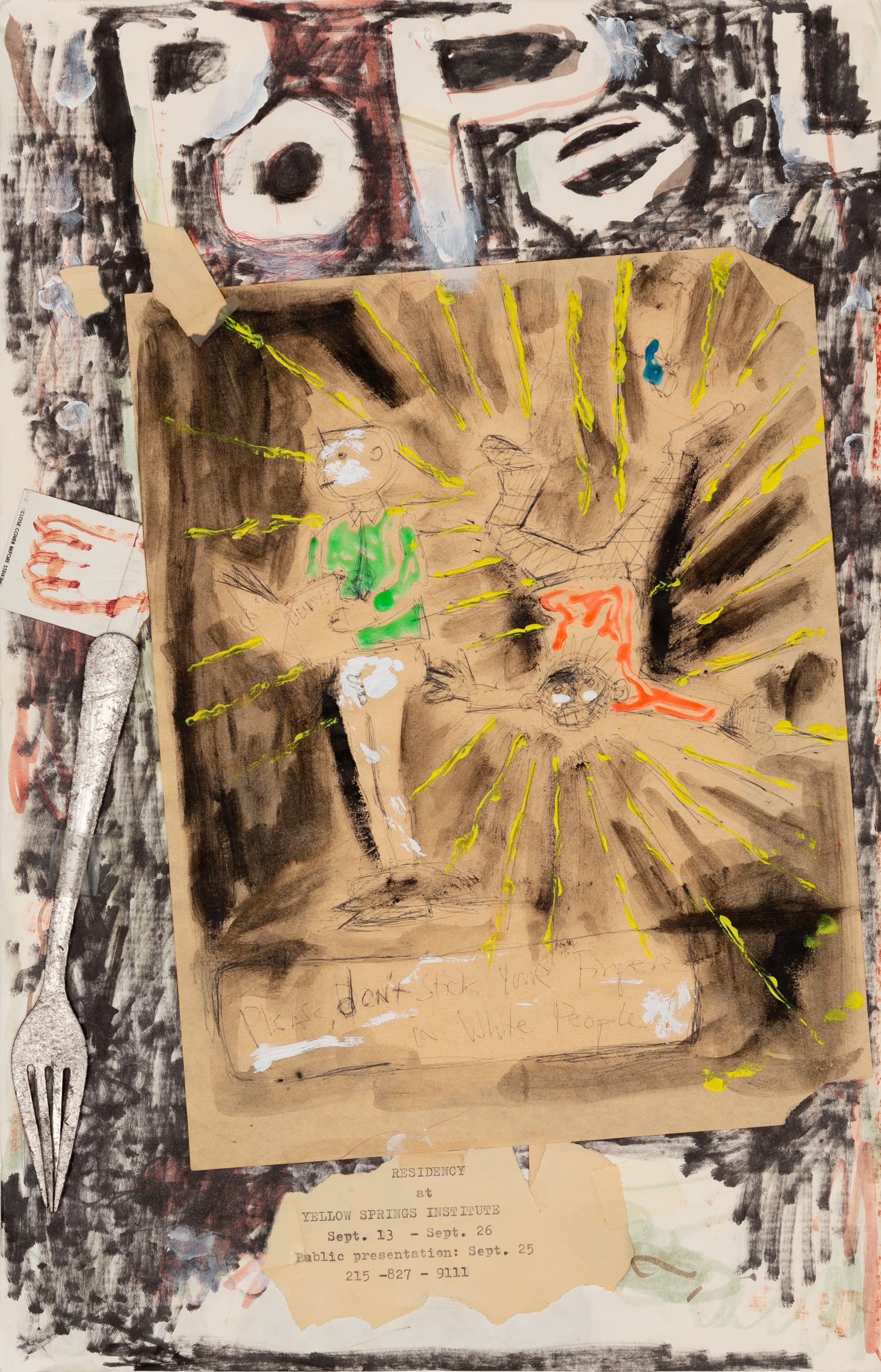
Like the drawings to the, when you come in, Skin Sets, then the latter-day Skin Sets, with the text. Where he's basically drawing the shape of text.
Or the in between of the, right?
Right. And then, the spaces in between lines of text. Talk about doing it interchangeably, he's literally making letter forms in this really scratchy way, so that's as literal as it gets. "I'm going to draw letters."
That's from your show, right? At the Renaissance Society.
Yeah, yeah. We had a whole, like a wall, for those two pieces.
When you were describing it, and I don't know whether it was in our interview somewhere else, you talked about it as an example of the medium of, another medium that he uses, and that was of lack. L-A-C-K.
Oh, yeah. That's, yeah, I...
Tell us a little bit about the medium of lack, given that we have an abundance of not lack around us, actually.
Well, I mean, lack. And he said-
Hole.
... right, I think he said lack was his medium, but you can't mention that without mentioning Hole Theory. So on the one hand, the dimensions of lyricism about the work. And again I would say, it could be just as lyrical as it is literal.
That's what's so strange, is that tension between the lyrical and the literal, right?
Yeah.
And it's paralleled in the tension between the conceptual and the perceptual, the object and the non-object.
Yeah. But when it comes to lack, or Hole, the literalness is like, "No, I want to make something out of nothing." But then, all of the-
Is it that, or is it embodying nothing? Maybe embodying what a nothing looks like?
Both, and more even, I would say. Because he gets into... I mean, there's Hole Theory, but when you read Hole Theory, that's really intense. I mean, for those of you who have never read Hole Theory, I highly recommend it. He goes places in Hole Theory that, I mean, knowing him, I always felt like he only alluded to relationship with his mother and stuff, and growing up a little bit. But in Hole Theory, I feel like it's like, whoo. It's really...
Which is a self-published book. We have it in a case downstairs, but I think it's, is it available? Somebody, Arnold? Yeah. As a PDF? Yeah.
There's definitely an online PDF, yeah. And that's different than... Lack, to me, is different than nothing, right?
It's the absence of something.
Yeah, right. And so, the kind of Freudian dimension and depth, and that's I feel like the real hope. That's what he is... So it's far more than something from nothing, right? He's working with lack, like the not having, the absent thing. And I would say in the deepest, most profound, and even violent Freudian sense.
I want to ask the audience something, does it sound to you like we're having a formal conversation? I don't mean formal as in, "Take some tea, please." But formal, as in honing in on the formalist elements of this artist's practice? Because I find myself, especially when, this is the second big conversation we've had, moving on to that. And I think that it's really interesting, because I think that... I mean, I guess my question to you is, there is something traditional about the way that he looks at art, Pope.L looked at art history. And I wondered if you could elaborate on that.
Oh, I mean, in that way-
I mean, is he a modernist? Because I could charge Kerry with that, every now and then. Yeah.
Well, no, this is how I answer that question about him being a modernist. When they x-rayed and found the racist joke underneath the Malevich, as they-
The black square?
... yeah, the black square, and the whole two Negroes in a cave fighting. For those of you don't know, Malevich's Suprematist Square was x-rayed in 2015, somewhere around then? Was it 2012? Relatively recent. And they found, beneath the... When they did the x-ray, they found a joke written, which is two Negroes in a cave fighting. And now, that is a reference to a series of prints that were made. It's a French artist who did a red one, a white one, a black one, and he made these jokes around these monochromes. And that was in the late 19th century, it was like 1870s or so, I believe.
And so Malevich took that joke, and inscribed it behind the Suprematist painting. I feel like, it's like, that's Pope.L. That's like, before Pope.L, that is everything, that's the DNA for Pope.L, is in the goddam DNA for modernism. It's like, there you have it, right? It's just, race as a modernist construct, all of it. Out with all of it. And it looks like this. It looks like vomit. This is what it fucking looks like. And that's where I feel like it's like, is he a modernist? In that way, in terms of the vomit dimension, yes. Like, "Ugh!" Let's actually talk about, what is the relationship between the two big, like race and formalism?
Well, that's what you mentioned.
So it's like-
Almost in passing, you said, "Pope.L treats race like a formal proposition." I was like, "What? Wow." I mean, let's unpack that a little bit because that's pretty shocking to me, in a way. That's putting narrative into something that's resistant to narrative, right?
Exactly. And that's the rub. That's where I feel like the work is, to me, that's the gasoline. That's what's fueling the engine.
How do you find out where the belief system is, if you're constantly contradicting yourself? You called Pope.L "pro-metaphor and anti-illusion," when we were talking before.
Oh God, I don't remember any of this, but that's pretty good. I like that.
But you also said, could you just say-
You caught me on a good day. I must have been, like-
But you also said that he was a concretist, that is, an anti-metaphorical guy.
Oh, yeah.
So which team is he playing for? Or is he playing for both?
Oh no, it's like watching an episode of South Park and trying to figure out what their political ideology is. It's like, "What the fuck?"
Yeah, that's impossible. It's true.
That's why I love South Park, because it's like, I don't know. It's brilliant that way. On the one hand it's like, "Oh, they're making fun of them." And then they're like, "Wait, no. That's me." So that's how I feel, Pope.L. It's like, do you want the red pill or the blue pill? The camps, it's just a rabbit worn, rabbit hole, or kind of the situation in terms of connecting those things, and then producing an illogic that is actually a part of them.
So is it just a matter of, maybe it's not like he believes in both, but maybe he doesn't believe in both. And that they're both, you also said that "he would use race as a formal proposition to describe the inherent absurdities in the proposition that is race."
Yeah. Oh, yeah. I mean, that's what I like about the Skin Set drawings. Like that, as an idea, as wacky as it might sound. And then it's like, "Oh, no. Art-wise, it's played out. Red, blue, yellow. Like, what are we talking about, here?"
So mechanically, how does he do it? So he creates these parameters, and then he plays it out in all the different possible permutations that he can think of, which is ad infinitum, right? So is there a connection then, to somebody like... My understanding is that Pope.L often said that his favorite artist was Robert Ryman, and he did several works that reference Robert Ryman. Is that the connection, that notion of within these very strict parameters, the permutations within the parameters, like what Ryman did?
I would almost want to say, Ryman is like a power figure for him, a power object almost. So Ryman is a complete package. Ryman is iconic of something. And so, what Ryman both symbolizes, in both how literal Ryman is, and a materialist, resolutely. But then, what do you do with all of the symbolic import of white, right?
That's the thing. Did he like-
And so-
... I mean, did he admire Ryman, or did he use Ryman?
That's what I mean by power object-
I guess you could do both.
... is that it's like a power object. Like, yes, he can use Ryman. And it isn't a critique, per se, of Ryman. It's more like a deployment. He represents, it's one of, a zenith of modernism and formalism in this way. So then the idea of then deploying it. Whole. So as opposed to critiquing Ryman, in part. Like Ryman meant something to him.
I don't know if we're done with the "race as a formal proposition," because there's this interesting car crash, in a way, between art history and real life, that is very enjoyable. I mean, it also hearkens back to the way that, the inception of formalism before it was an art historical term, and being a term of political philosophy.
Well, that's part of the rabbit hole. If you get into... I mean, it's very interesting, when Greenberg was accused of being a formalist. Because I really said, "He didn't..." Oddly enough, he responded wholly on the money, and then at the same time was quizzical about it. He said, "Formalist. Well, to my mind, that's a group of Russian literary critics."
Yeah, right.
And it's like, "Ooh my God, you actually know. Correct. Yes. And your thinking belongs to their project." It's like the idea of a science of culture, a science of art. But at the same time, the idea of the science of race, in terms of its very checkered past. So those things, again, do you want the red pill or the blue pill, in terms of how these things could marry or go together? And I feel like that's-
I mean, there's a politics of formalism, right? I mean, just at its very base, against narrative, for example. And narrative, of course, is the great tool to put your point across, as is metaphor, as is allegory. And if you reject those things, I mean, you have to write on the back. You have to write something on the back saying, "What you're really seeing is two guys in the darkness."
Right, right. And to have that inscribed in one of the modernist icons is one thing. But before, I would say before formalism acquires the valence of being the opposite of metaphor or narrative, the idea that formalism is actually an analysis, a way of analyzing, how does literature work? So doing a formal analysis of language and sentence structure to figure out what affect? And then, how are the words on the page producing affect? Can we actually break the literature down, to talk about the aspects and dimensions of artist X-Y-Z's style? To talk about how does this work?
So formalism, insofar as, again, it's an operation on works of art to discuss the production of affect in concrete terms. "So this is how, emotions are generated this way." So, in which case, it's not necessarily opposed to those things, but started that. But once you start to break it down, and then the issue of abstraction comes in, then it takes on the character of being, you can no longer... It then stands as opposed to narrative. But I like to think of Pope.L's, again in terms of using these terms to describe or talk about him, in those more complex terms where they're not necessarily opposed to one another.
That's right. Yep.
And then you can find more interesting linkages, when you begin to take the terms apart.
That's what you're doing, that's what you do in our discussion, and what you're doing right now. And I think that it really does, it opens things up. And I'm being very, kind of Mana Key-ing this or that, but that's the way that I've been able to... I've tried to grasp this very multifarious ouevre that the artists had. And also, the second thing, and this is the most potent thing is, shaving it down to a medium. Just to works on paper.
But to go a step back, though, what I was saying about the Skin Set drawings, and the production of affect. It was interesting, you wanted to do a postering campaign, a wheat paste campaign, with some of the Skin Set drawings, and you let the designer choose which of the Skin Set drawings they would put out in public. And they chose seven of the Skin Set drawings. And then the idea, when Christine and Larry were here and they said, "No, no, no, no, no, no, no."
Tell them what we didn't choose, that we chose colors. We didn't choose any Skin Set that could have been perceived as racial, like real colors. So black, white, red, yellow-
Right. Which is-
... are the three that are not part of that poster.
... negates the Skin Set drawing. So when you look at the Skin Set drawing, you're like, "Purple people are the why and the how-"
That's right.
... "of nuts and bolts." "Hm. Fuck. Okay." You go, "Black people should be nice to their anger." It's like, "What the fuck is that?" It's like-
That was why we didn't do them.
... "Agree." It's like, what are these questions, and why do the questions work? Some questions you look at, you're like, "I don't know about that." And then another question, you're like, "I don't understand that." And so they are literally fucking with this at the level of, they produce affect on the spot. But the language, red, yellow, blue, orange, is formalism. So that's a literal example of Pope.L being like, "Okay, what are our feelings about these statements and propositions, that the Skin Set drawings are?" And so that's why they're... But again, the beauty of the Skin Sets, it's like, "Oh wow." It's all right there, and quite literal.
And PS, we decided not to do the wheat paste campaign.
Right. Because it got rid of, you're not being true to the work. In terms of, in its full complexity. So you have to offend, or you have to feel uncomfortable within the range.
I mean, that's a question, and it links to the next one I was going to ask you about the object, because we talk about Pope.L as a conceptual artist. For those who don't know, he was very influenced by Fluxus and studied with Flux artists. And one could say in general, again looking at the Fluxus guy over here, that it's not an object-oriented group of artists. And yet, we're sitting in a room with 250 objects. And when you do a drawing show, that object orientation can sometimes be unavoidable. And in this case, it is. So we are presenting Pope.L as an object maker, in all his glory. And what do you think? I mean, are we looking at another "he is, he ain't"? He's an object guy, he's not an object guy?
Oh, no. Yeah, I wouldn't go into those. Again, being very literal, so even if it was anti-object, it would still acquire a literalness to it, where that suddenly kind of negates, at least for me. Because I still think of Pope.L as quite material.
Yeah, I agree.
And it's resolute material. Even though how the work works on me, and what it does to the thought process, how he gets inside my mind.
You just said that that was the key thing about Pope.L, so that doing a wheat paste campaign without the actual races, actually messing with people's heads, wouldn't be Pope.L. Right?
Right, it wouldn't be Pope.L, right. I mean, the beautiful thing about doing, the imaginary collector that I am is like, "Oh, I like this one. I don't know about that one." Which of course, then it becomes their subject to your take as opposed to like, "I mean, if you really want to do this game, you got to go for..." As opposed to like, "Oh, this one makes me laugh, and I feel comfortable with this one. This one is silly, so I buy this one." Which is fine, because why? That says something about you.
And again, and maybe I'm simplifying, but the anti-institutionalization of the practice, is to me clear, and also familiar with artists of a certain generation and maybe one generation younger. But the artists like David Hammons, or Cayalta, or Elizabeth Pey... Sorry, misspoke. Trisha Donnelly, all of them have this... They exhibit in galleries and museums, but they are at war also with those, because they don't want meaning, the screens of meaning. And I see that. I didn't know Pope.L, I never worked with him during his lifetime, but in a way I could feel that. And yet. Yeah.
Yeah, he-
Was he? Is he? And yet, he made objects.
... oh, right. But, I mean, Pope.L was no more or less difficult than art itself. So that's to take it off of him the person. So he put something out which, he recycled an idea, and I didn't know it at the time that he had recycled this idea. But it took on much more dramatic consequences when we worked with him for his solo show at the Renaissance Society, where he wanted to do a wall that was smeared with peanut butter. And somehow, some way, I don't know why Karen Reimer, the registrar, thought to run this up a chain of command. I don't know why.
First rule of that, don't tell anybody.
Right. And she thought to run it up a university chain of command, which we never do at the Renaissance Society. And so, it went through whatever normal channels. And we got a letter back, and it didn't come from the office of the president, the provost. No, it came from a higher authority, University of Chicago Risk Management. Much higher authority. Somebody there, and this was kind of brilliant. And I don't know if we ever told Pope, but if he found out, I'm sure he would've wanted to publish this.
Somebody looked at what he wanted to do, and recognized that the air intake vent was seven or eight feet away from that wall of peanut butter. And it was a big vent, for all of Cobb Hall. And they just shut it down. They wrote a letter that was like, you couldn't even respond to it. It was like, "This won't happen." It's like, "Period." That was it, literally, from risk management. And it was like, "Got it. Okay, move on to the next idea." So he didn't, and for obvious reasons, but there was no hurt feeling or anything like that. It was a proposal from Pope.L. So he would put stuff out.
And then, it was nice when things were yes or no, because then if they weren't, they could fall prey to a very gray area with him, in terms of negotiation. And he loved that game. So then he'd be, "Well, why not? Why not?" So, "Okay, okay." But he would always come back. "So answer me this about it." Had this funny way about it.
This is a broader question, but it goes back to why we named the exhibition what we did, and I'm going to read you the quote from Pope.L, from which we took the title. He says, "To mark anything," drawing, "is to create a difference. Maybe a world, maybe a wound, and certainly an act." So obviously, he's implying definitely a kind of activism, and we used it because the drawing is the active thing. To make the mark, the actual mark, is what happens. And I wondered what you thought, is it a vehicle, the art is a vehicle towards a kind of activism? Or is it the object itself to which, as you were alluding to, as we read a Skin Set. That's the thing that makes us angry, puts our hair on fire, makes us go change the world.
That quote-
You said he had a million of them. That's what you answered, when I [inaudible 00:43:36]-
Oh, yeah. I mean, all of his stuff, when you read. It's, just the idea of mark, and difference, wound. It's very eloquent. He's a very eloquent thinker and writer, and no matter how absurd, they were always still quite eloquent. But within that one, the idea of marking and difference, to me immediately it's like, "Well, no. There are politics." To me, the politics of what he's saying are quite clear, in there. Even though he's not falling on one side or the other, but to talk about to be marked, as a way of being different. So the very idea of, there are those who are marked and therefore different-
Yeah. Oh, I see.
... versus those who are unmarked, and not different. That's what that quote, to me, conjures.
That's so interesting.
And I know that this is where Pope, you feel like this is, it's like, "Wait." So he-
Do you see what he did? He made a noun a verb, which is super interesting, in that way.
So the idea of, the politics being like, "No, no, no, no, no." It's not like, "Oh, well. You, with your ethnic baggage," or whatever. And then, "I, who have no baggage at all." It's like, "No, no, no, no, no. It's either like, 'No, we're all marked.'" And so, at least, that's where the politics of that statement come in, to me. But I know that that's what I feel like he's provoking, that discussion, even though he drifts into other areas, suddenly. So when he talks about it being a wound, so lack, and stuff. Really, really, really beautiful.
Quote about that. I have one more question, then we're going to open it up to everybody. And that is, that Pope.L once said that, "Artists don't make art. They make conversations." The conversations that Pope.L started with his work about social absurdity, the absurdity of classifications, whether it be name, type, or even race. What does this mean post-Pope.L, now that he's no longer with us? Who's having the conversations, and are we still having conversations?
Yeah. It's funny. I was looking at his drawing, Water, and it's the word water. And I was thinking about his show at the Whitney, which is-
2019.
... the 2019 show at the Whitney. I don't know. That show was incredible. Incredible. The big water drawing, where he plugged into the Whitney's plumbing system. So the whole, everybody was there, it was like... And so that very question, it's like, "Hm. Do you think he knew Ray Johnson? Do you think he knew Michael Asher?" It's like a malice tour. It's not goodwill towards all. So all the many layers, but then, the religious dimensions of water, or he had the video component of it. But then the real thing that he was looking at was Flint, Michigan. Was it Flint?
Oh, the water crisis. Right, right.
The water crisis in Flint. It's in Flint, Michigan. And he did the gesture where he took water from Flint, and then brought it to New York, and then poured... The video of him pouring a bottle of it into the-
The system.
... into the, was it the Hudson? So the idea of, post-him, I feel like it's like, "Well, no, because of things like Flint. He's everywhere, all the time." And that's what I feel about his art in any newspaper article that you read. So it's not, I was saying before, he's still, it's untimely death. We're still trying to catch up to him. And that's what I mean, so the idea of like, "No, no, no, no, no. There's no post-Pope.L in that regard, insofar as we're still chasing after him," in terms of how he's able to signify things, represent things like the Flint water crisis with that level of smarts, and artistic touch, and sensibility. If you think about his way of, that's one way of dealing with it, versus LaToya Ruby Frazier, for example, who did the hulking photo documentary series, in different ways.
But it was beautiful working, we were working with him for Monuments, when he died.
We were. Oh, yeah. He was part of it.
And so-
Yeah.
... right. And he initially, the city of Charlottesville, unlike other cities, they took their monuments down. But because of the Unite the Right rally, Charlottesville got rid of their monuments. The people actually said, "No, we won't stand for you taking them down and putting them in storage, and putting them in the basement. You have to get rid of these things." So the city put out a request for proposals from organizations interested in taking possession of them. And I said, "Okay, we're actually going to put in a proposal." And I went to Kara Walker and I went to Pope.L, and I said, "Okay, we're going to ask for both the monuments. So if we get these monuments-"
Audience 1: That's Lee and Jackson.
Lee and Jackson, right. And then, "I'd like to give one to you, Pope.L, and one to Kara." And then the city of Charlottesville came back and they said, "Okay, you asked for two. We can only give you one. We're going to give the other one to the hometown heroes." "Okay, we'll take the one." And then we gave it to Kara.
You got Jackson? Andrew Jackson?
We got Jackson. We got Jackson, and we gave it to Kara. So jokingly, and very slyly, Pope.L kept saying, "Man, where's my monument? You said I was going to get a monument. You got my hopes up about the monument thing." And so, he said, "Okay, can you get me some crumbs from the monuments?" And by crumbs, he meant all the nuts and bolts, brackets and stuff that, after they take it down. That he just wanted, he called crumbs. And I said, "Yeah, we could score you some crumbs." And I told Kara, after she'd finished her piece and saw it at the foundry, and she had all the things that she didn't use, which were crumbs, on a moving blanket. And so when I told her, Kara goes, "Oh, I got crumbs galore." So she packaged up all the pieces and sent, and then he passed away 10 days later, after we got receipt of the package with crumbs.
So this is our, inside of the show, there's a memorial gesture to Pope.L, and this again is to say that there is no post. So we did borrow the Robert E. Lee statue for the show, but from the Jefferson School of African American Heritage, because they melted it down. And so we said, "Great. We'd like to show it in its melted down state," which was-
Those were those bullions-
... the ingots, yeah.
... or ingots, right, yeah.
Right. The ingots of bronze. But the bronze was dirty bronze. It was so toxic that... There was no EPA when they made the statue. But you couldn't melt it down and just give the bronze to an artist to make a new work, because it was just too toxic. So they had to purify it, basically pump argon gas through it to take out all the lead and tin, to get this pure red bronze. So when we went to the foundry, there was this big vat that was all the slag, and it was all the impurities from a Confederate monument. So I just said, "That. That's going to be in the show. That is the Pope.L that we don't have in the show." And it was just like, Pope.L is just produced, through the absurdity that is us, every day.
Audience 1: Yeah, he was.
So that would be my answer to that.