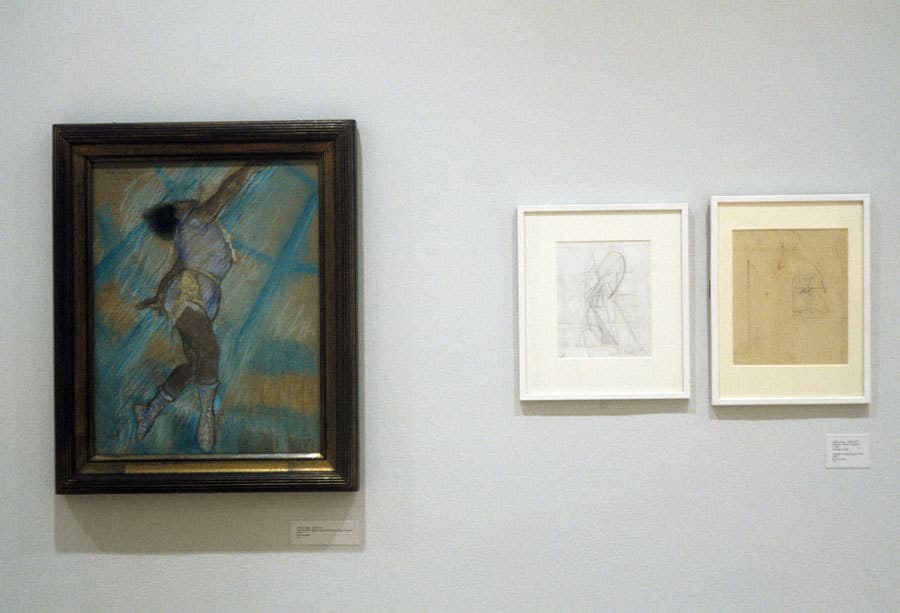
The Stage of Drawing: Gesture and Act. Selected from the Tate Collection
April 5 – May 31, 2003
ViewPlease note our galleries will be closing early at 4pm on Wednesday, November 18, for a private event.
April 12 – May 31, 2003
In a variation on the Selections series of exhibitions, The Drawing Center invited eight emerging artists to develop drawing-based public art projects and performances. Street Selections made use of various sites along Wooster Street, between Canal and Spring Streets. The Drawing Center's Drawing Room gallery functioned as a node from which the various projects emanated. Spilling from the gallery space out into the surrounding streets, the works in Street Selections unsettled Wooster Street's urban surroundings.
Amy Bay explored the patterns, human errors, and other idiosyncratic details that could be found in bricks on neighborhood walls. Rather than creating realistic representations of these walls, Bay employed techniques traditionally used to create illusion to highlight the imperfections that were inherent in markmaking. Working as a collaborative team, Jesse Bercowetz, Matt Bua, and Ward Shelley approached markmaking from a performative standpoint, exploring the possibilities of using a moving truck as a tool for drawing. For one of the variations, the artists drove through the streets of SoHo while one of the artists, strapped into a harness, drew on the truck cabin's paper-covered walls, barely able to physically control his own markmaking. Their Drawing Room installation included video footage of the performance taken from multiple vantage points.
Harrell Fletcher demystified the persona of the artist through the production of humorous "bulletins" that reveal the importance of both process and audience in the making of artwork. During Street Selections, Fletcher set up a folding chair and table along Wooster Street and invited passersby to participate in a two-way interview. These interviews resulted in a set of drawings and opinions recorded in the format of bulletins, published en masse and consisting of several pages documenting these exchanges. The bulletins were available in The Drawing Room. Cecilia Galiena's subtly humorous wall drawings focused on language, specifically the symbolic yet ephemeral interaction between words and images. In her wall drawings inside and outside the gallery, Galiena combined street graffiti with philosophical ideas on language, politics, and experience.
Rebecca Herman used the concrete of the sidewalk as a drawing support, creating fake cracks that suggested the slow, persistent movement of the earth's surface. In the Drawing Room, she projected an animation that imagined traveling through the open fault lines as the street folded in on itself and the natural and manmade landscapes collided. Jamie Pawlus created unique street signs by silk-screening her original sketches onto aluminum supports. She used the easily recognizable format of the street sign in order to communicate strange, incongruent, and often unintelligible directions and messages to the passersby. Though cloaked in the guise of a navigational tool, each sign lacked utility, a contradiction used by Pawlus to guide viewers into an imaginary beyond.
Curated through The Drawing Center’s Viewing Program.
Major support for this exhibition was provided by The Annenberg Foundation, with additional support from The Horace W. Goldsmith Foundation, Federal Council on the Arts and Humanities, Dedalus Foundation, and The Michaels Family Foundation.
April 5 – May 31, 2003
View