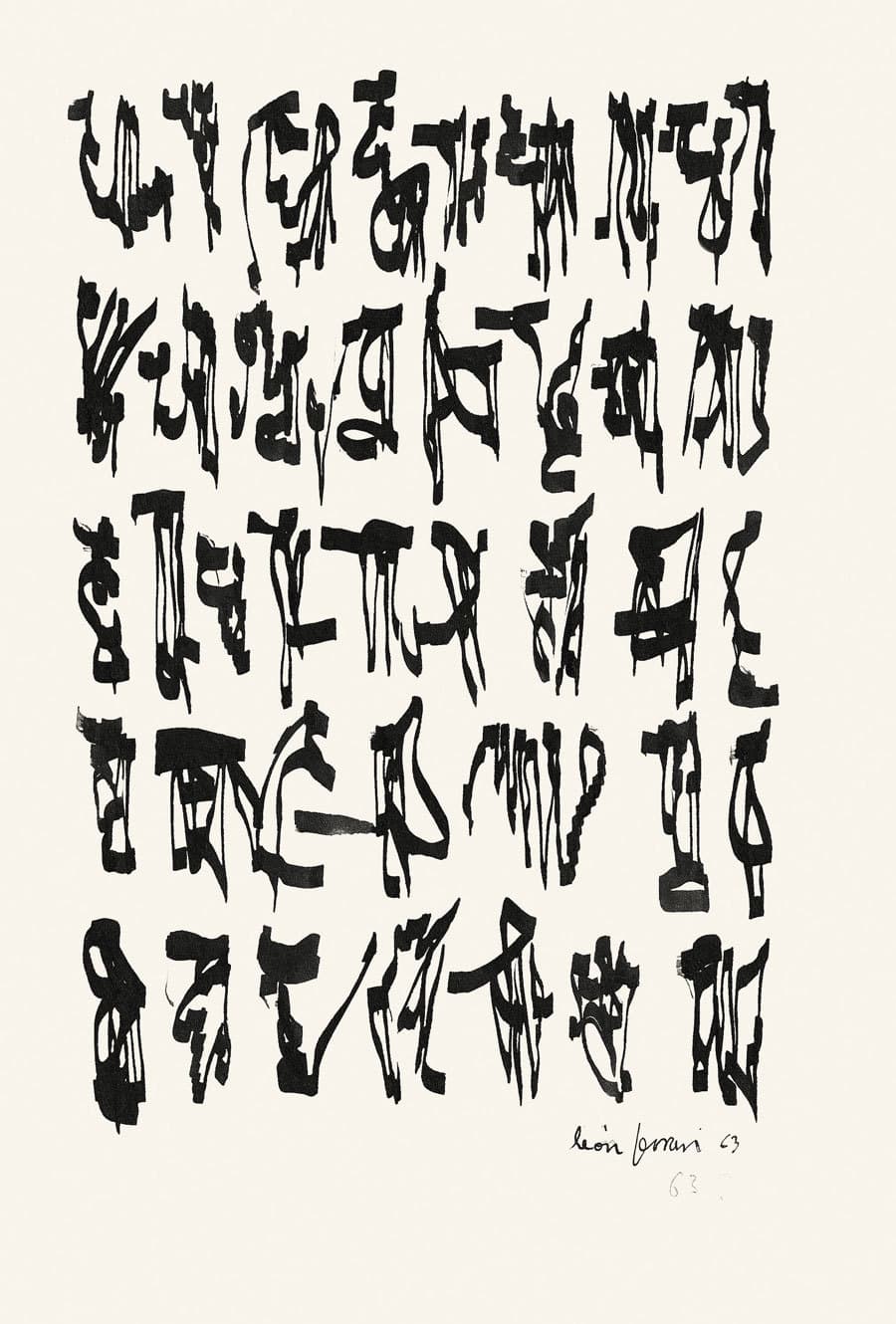
León Ferrari: Politiscripts
September 9 – October 23, 2004
ViewSeptember 9 – October 23, 2004
Selections Fall 2004: Talespinning presented the work of fourteen artists who explored allegories of the fantastical, the uncanny, and the mundane. Influenced by diverse sources such as literature, fairy tales, comics, newspapers, atlases, and hand-made signs, the artists produced works in which reality and fiction collided without resolution.
Noriko Ambe (Fukaya-city, Japan) cut ravines through hundreds of pages of newspapers and atlases to create emotional topographies that charted subtle human relationships to the physical environment. The drawings of Alice Attie (New York, NY) were composed of monologues and fragments of texts by Franz Kafka, William Faulkner, and James Joyce. Attie interweaved words and images, playing with the concept of the calligram to visually articulate the elusive nature and eloquence of memory and imagination. The self-portraits of Ambreen Butt (Cambridge, MA) were influenced by traditional Persian and Indian miniature painting. Her drawings interlaced myths, personal histories, and current events, tracing the uncontrollable nature of these different elements and their impact on individual lives. Jonathan Swift's Gulliver's Travels and stories of nannies and maids were sources for Zoë Charlton's (Baltimore, MD) fantastical drawings, which revealed intersections of race, class, and gender.
Alejandro Diaz's (Forest Hills, NY) hand-written cardboard signs and performative interventions incorporated canny observations on the seemingly trivial to comment on life in the city, the political landscape, and art institutions. Geoffrey Grogan (Brooklyn, NY) recycled the pages of the New York Times into large and incredibly intricate collages that invented new narratives for classic comic book heroes and horror film monsters, such as Superman, Frankenstein, and Dracula. Using historical postage stamps, Jonathan Herder (Brooklyn, NY) fabricated visual allegories and epic stories of war that chronicled the melodrama of U.S. history. The fertile imagination of Nancy Jackson (Los Angeles, CA) manifested itself in beautifully rendered landscapes and underworlds in which various characters embarked on metaphysical and fantastical adventures informed by German Romanticism, Shaker visions and testimonials, Surrealism, and Venetian genre paintings.
Ricardo Lanzarini's (Montevideo, Uruguay) exquisitely drawn miniature booklets were cultural diaries that recorded the human condition on leaves of cigarette papers. The wonders and alienation of everyday life became humorously apparent in Tucker Nichols' (Mill Valley, CA) drawings, which captured overheard snippets of conversation, spontaneous outbursts of joy and annoyance, and highway billboard messages. The thousands of fluid lines in the drawings of Eung Ho Park (Brooklyn, NY) created an enormous network of intertwined roots to suggest an ever-expanding story of interpersonal, generational, and societal links. Catharyne Ward's (London, England) ornate scratchboard drawings of torrents of human hair rendered gothic landscapes that evoked fairytales and folklore of love and loss. Jennie White (London, Ontario) memorialized banal descriptions of everyday emotions in her updated version of the sampler, made of paper delicately perforated into a ritualistic pattern of holes. Amy Wilson's (Jersey City, NJ) series A Glimpse of What Life in a Free Country Can Be Like inserted extracts from right-wing and left-leaning political sources into fantastical landscapes of sweet-looking girls reminiscent of Henry Darger's drawings.
Curated through The Drawing Center’s Viewing Program.
